- Involved the local community in its creation, granting participants access to the therapeutic benefits of making something together—while not sacrificing the artist's strong, coherent vision and well-developed sensibility
- Creates ongoing opportunities for residents of and visitors to the neighborhood to meet and build connections, and to have access, at no cost, to the salutary and stimulating effects of exceptional art
- Raises awareness of the local place where it's sited, increasing foot traffic to and identification with the park and the neighborhood
- Possesses qualities of the truly mysterious, surprising, and beautiful, encouraging acts of urban escapade and discovery that are not commercial/market-mediated
- Is broadly accessible, both physically and conceptually (it's hard to imagine someone unfamiliar with trends in art feeling it's "over their head" and therefore alienating)
- Is temporary, liberating it from pretensions to monumentality and better suited to the vicissitudes of the urban environment—anticipating and avoiding situations in which its maintenance over time would drain organizational/municipal resources, or in which it would decay, like so much environmental art in and around Detroit, due to the lack of those resources or a realistic long-term plan for its maintenance.
Thursday, December 2, 2021
Wicker Park: Looking at "Stickwork" in Detroit
Sunday, October 3, 2021
Blissed
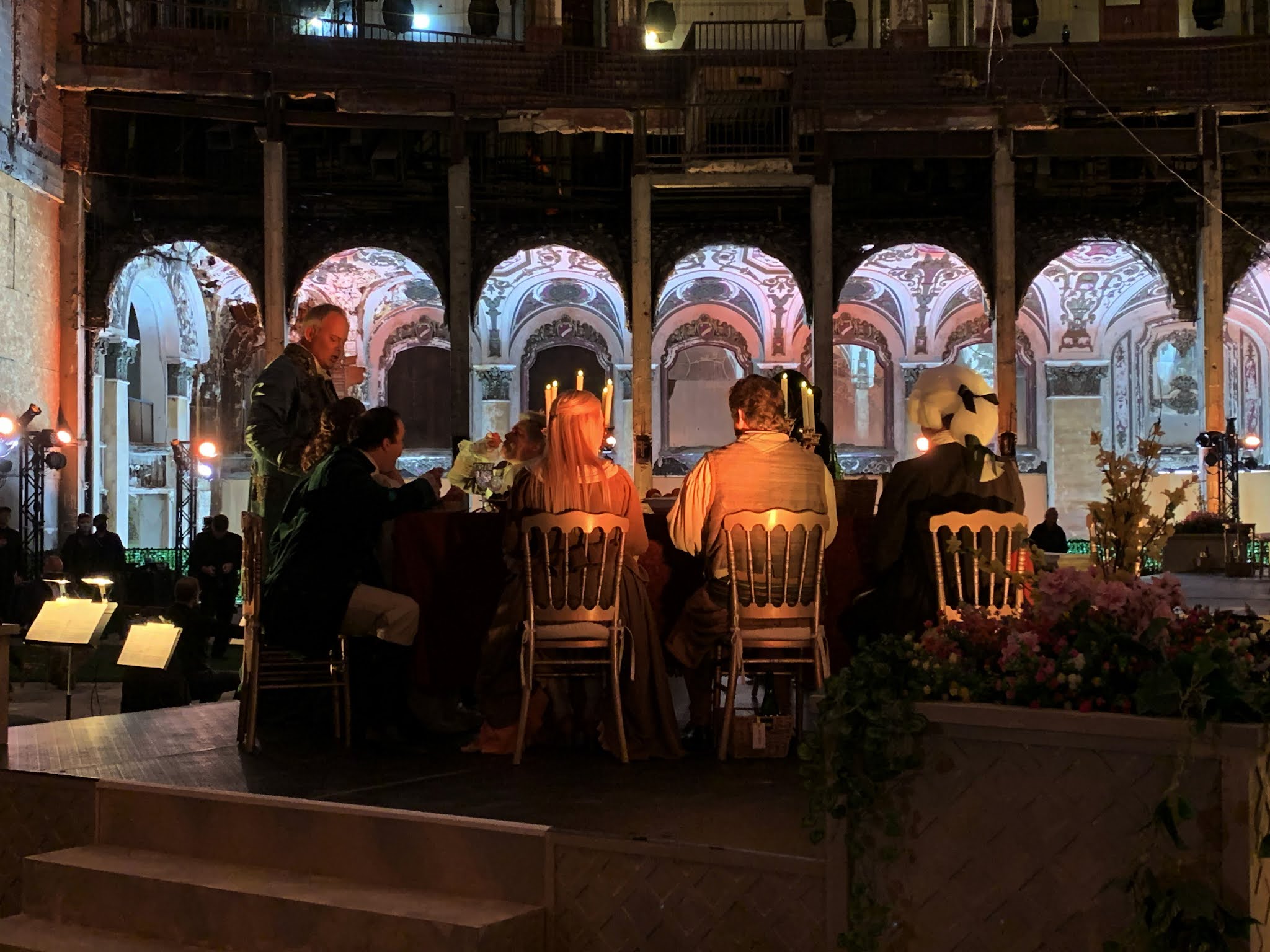
It's been eight days since the Detroit production of Bliss, the titanic performance installation staged by Michigan Opera Theatre in the ruins of the old Michigan Theatre, and here I am still bobbing along like a lifeboat in its wake.
Somehow I did not expect this. Going into it, I did have the feeling that I would probably love the experience of attending Bliss, a twelve hour opera event originally conceived by Icelandic artist Ragnar Kjartansson, in which three sublime minutes of music from the conclusion of Mozart's Marriage of Figaro—the moments when a count publicly asks his wife's forgiveness for attempting to seduce a servant and, much to their community's joy, she grants it—are repeated over and over and over again.
If this makes the performance sound static or dull, it wasn't. The staging of each three minute cycle varied, subtly or dramatically, from the one before it; the light changed entirely as day turned to night; and sometimes there was dancing. The audience, meanwhile, was invited to come, go, and move around as we pleased. With audience and production ever in flux, there was a sense of constant renewal and change against the perpetual backdrop of the music.![]() |
| Corey McKern as Count Almaviva. He only took two short breaks in twelve hours! |
And I did love being there. It was the tops—one of my all time great performances. I was immersed in Bliss for about five hours, all told, with a short break for a walk around the block and a longer one for dinner and more art (during which I nevertheless felt tugged, insistently, back to the theatre), and my experience was everything I hoped it would be: overwhelming, surprising, dreamlike, joyful. Ecstatic. Intoxicating.
More generally, I have felt, in ways that aren't necessarily easy to put into words, more at ease, more relaxed, more inspired, more myself. Less clenched. I have the sense of having unburdened a certain amount of weight I've been carrying this summer, this year, this pandemic. I'm operating from some new baseline of contentment. This can't last, of course, and every day I can feel the distance between that time and the time I'm in grow a little wider, but for now, I'm living in it, I'm looking at it, and I'm feeling profoundly grateful for whatever on earth Bliss did to my brain. (Honestly, someone should do a study.)
But so what? you might reasonably ask. So what if I'm over here feeling blissed?
Well, I've been thinking about that. By making the decision to stage Bliss at the Michigan Theatre, one of Detroit's most well-known ruins—a once glorious palace that was infamously converted into a parking garage in the 1970s—MOT's new artistic director Yuval Sharon had a stroke of genius that I think accounts for some of the work's peculiar punch. This was not merely an exciting, dramatic, eminently Instagrammable backdrop for Bliss (though it was that, too); it was an opportunity to place the production's theme of forgiveness in a particular local context to profound effect.
In his brief but trenchant program notes, Sharon notes that the repetition of those three minutes is Kjartansson's way of suggesting that forgiveness is itself a durational experience: "a marathon, not a sprint." A process, not an event.
By staging his Bliss in the Michigan Theatre, Sharon granted Detroiters and suburbanites alike an opportunity to embrace one of the City's ruins in a way that no major arts organization has done here, as far as I'm aware—to inhabit it, to look right at it, to be in it, to wonder in it, not to avoid it or shake our heads at it, or even objectify it in that way that ruin porn is criticized for doing. The audience became part of that place, or rather we were given the opportunity to accept that we are a part of it, and that it is a part of us.
We were invited, in other words, to engage in a process of forgiving the City for its failures, of which the Michigan Theatre is a particularly vivid example.
On one hand, there is a civic dimension to this, in which the individual audience member could be said to have been invited to forgive "the City," writ large, for the grievous sins the Michigan Theatre represents—racist disinvestment, decline, and disrespect, auto-mania, forgetfulness, self-sabotage...the list goes on.
But then again, as several wise Detroiters in my life have asked to powerful rhetorical effect, who is the City if you're not the City?
There is a deeper level here, where the City is not some historical abstraction but the people in attendance. I think Detroit's Bliss gave audience members the opportunity to forgive ourselves; that's why I've been floating through my week. That's why it matters.
Every day today, we are bombarded with evidence of our failures. On social media, in the news, we are confronted with an endless litany, a barrage of failure: our failure to protect the natural world we fail to remember we're part of, our failure to get along, our failure to protect and care for the most vulnerable among us, to respect one another, to connect with and learn from each other, to separate fact from fantasy.... We live in a world of failure now. It seems inescapable.
In Detroit, perhaps more than in many other places, we are somewhat used to inhabiting a landscape of failure. We cannot help but be reminded of our collective carelessness every time we leave the house, by every closed library and abandoned school, every gutted, treeless expanse, every parking lot where a building used to be, every residential neighborhood situated near a toxic industrial facility or ripped in two by concrete conduits for cars, and the reality is that daily life in this nearly unremitting chaos takes a psychic toll. How could it not?
Bliss offered its audience no solutions to our endemic problems. Instead, it gave us, briefly but penetratingly, a large measure of redemption and grace that we desperately need in our ruined, wasted world. This is akin to the kind of regenerative grace we might otherwise find in nature or in community, compressed by art's magic into twelve hours that gestured toward the eternal. Through its repetition, its beauty, its sensitive siting and its scale, Bliss gave us a useful tool we could carry with us and share, a device for remembering and accessing peace when we need it. And it left us rich with the real fruits of forgiveness: a shift in perception, a new frame of reference, a chance to begin again.
Sunday, November 15, 2020
To María
Last month I learned of the passing of Dr. María Gonzalez, an extraordinary woman I had the good fortune to know during my graduate studies in Library and Information Science at Wayne State nearly a decade ago.
María taught a seminar on the role of information professionals in urban environments that, looking back, I can easily say was the most impactful course I took while earning my Master's. I wish I had hung on to the syllabus so that I could recall it in finer detail, but the theme—advancing the common good by facilitating knowledge exchange in urban communities—is unforgettable.To María, librarians and other information professionals carried a responsibility to stand up and be counted, to infiltrate the halls of power armed with values, strategies, and resources that would advance the connectedness and wellbeing of common people. An avowed urbanist, I think she saw cities, with their overlapping layers of commerce, history, power, and poverty, as places where civically minded people of all stripes could have the greatest impact. She was an activist, demanding engagement in her quiet yet fiery way, at the same time she was a pragmatist, making sure our eyes stayed open to the ways that business and government actually worked. She introduced me to the concept of social capital, or the resources and benefits gained from social ties, when she had us read and discuss Robert Putnam's "Bowling Alone," which examines some of the ways that civil society and social cohesion in the US have eroded, making us a "nation of loners" (as many commentators have summarized Putnam's central concern).
María was rooted in place. More than anyone else I knew at the School of Library and Info Science, her class was of Detroit, not merely in Detroit. Her borders were porous, and the city flowed in and out. It was this spirit of presence in place that made her stand out there, and that I have to thank for my employment at the business I've helped lead for more than seven years.
María was a flâneur, a stroller of city streets. Not confined to Wayne State's superblock campus, she walked the neighborhood around the university. That's how, in 2008, she got to know Tom and Peggy Brennan, Mitzi and Don Carter, and Helen and Tom Bradley, together the cofounders of the nascent Green Garage, which was to become a community-minded shared workspace and sustainability demonstration center in the Cass Corridor.
And that's how, in 2010, I first connected with the Green Garage, undertaking a semester-long project that turned into a volunteer opportunity, then part-time writing work, then a nourishing full-time leadership role that has become my professional center—one of the main wellsprings of my own social capital—since 2013.
![]() |
| My first visit to the Green Garage, 2010, with Ian, a fellow student, and the late Tom Bradley |
I often tell the story of my chance connection with the Green Garage as facilitated by María. Each student in our class was tasked with helping a Detroit business or organization meet an information need over the course of the semester. In the seminar's first days, María handed out the predetermined list we had to choose from, and I remember feeling particularly drawn to two organizations: the Museum of Contemporary Art Detroit (MOCAD), which I knew fairly well, and the Green Garage, which I only knew from a short article I had read online (something about green business; something about the transformation of a neglected thoroughfare into the city's first green alley).
I remember the sense of taking a leap. I remember thinking that MOCAD was the obvious choice. (I loved art, I wrote about art, I visited the museum regularly.) And I remember thinking to myself, "It's grad school; go out on a limb. Pursue the less likely path. Meet these green business people." It goes without saying that I'm glad I did. I've had the good fortune of enjoying formative relationships with several beloved teachers over the years, but María is the one whose influence materially changed the course of my life.
Not long after our time together, María left Wayne State, and the sense among people I talked to about it was that she was too progressive for the stodgy library school. They had irreconcilable differences, I guess, and María moved away, first to Delaware and then Los Angeles. She continued to teach, working in the Public History departments of Rutgers and LaSalle University. We kept up with each other on Facebook, where she would make loving, out-of-the-blue posts on my wall ("My best to you always!") and where she played the part of a Green Garage superfan, forever encouraging the business' growth and cheerleading any good news we shared. I didn't know until after her death that, in recent years, she had been diagnosed with cancer, and then ALS. Our last communication was a breezy, friendly greeting in March.
The time that María and I had spent together was rich, but it was largely defined by the classroom, where she was purposeful and focused, and Facebook, where she was fleet. In the days after I learned of her death, I began to wonder about her life story. I knew only the barest details of her biography: that she was Cuban-American (she spoke beautifully accented English) and that she was queer (I don't remember how I came to know that, but I couldn't help admiring her more for it).
I decided to reach out to Chela Metzger, Maria's partner of 20 years and a librarian at UCLA, to learn more. Chela generously filled in the gaps of María's extraordinary story, some details of which I'll recount here:
María was born in Havana in 1950. Chela says that it was in Havana where she began to develop her lifelong love of buildings and construction. At the age of 11, she and her grandmother fled to Tampa, Florida to escape the Cuban revolution, in which several family members had been killed. (Her parents escaped and joined them one year later.) After high school in Tampa, she went to UCLA, then Kent State to study architecture.
After time in New York City and Provincetown, María went to Seattle, where she worked in the construction industry, both owning her own commercial construction business and later developing clients for a large national firm.
In that capacity, she was invited to join the planning commission for the new Seattle Central Library, where she developed an admiration for Deborah Jacobs, the transformative City Librarian who spearheaded Seattle's historic, citywide library building project. It was this experience, Chela told me, that led María to librarianship, and to the University of Texas at Austin, where she completed her Master's and PhD and from where she decamped to Detroit to begin teaching at Wayne State in 2008.
![]() |
| Arcosanti. Photograph by Rosa Menkman, 2018. |
Friday, July 3, 2020
Essay'd: Lester Johnson
![]() |
| Lester Johnson with Continuum, 1974, Detroit News photo courtesy of Walter P. Reuther Library, Archives of Labor and Urban Affairs, Wayne State University |
Thursday, April 16, 2020
Daylighting 'Glacial'
Nawrocki describes Crystal Transformation as a "highly geometric," nature-inspired sculpture whose "nine units...grow larger and change color...as they move in a broad arc from the bottom to the top of a small hill."
Glacial, meanwhile, is an "audaciously simple sculpture" that "consists of two [polished] quarter-inch stainless steel planes" installed flush in a lawn, "one essentially rectangular (five by ten feet) and the other triangular (three feet per side)," that "[suggest] airborne views of glacial lakes, or pools of standing or frozen water."
Drawn as I am to most things minimal, environmental, and geometric (ah, the '70s: a country I never got to visit in person but where my sensibility has apparently taken up permanent residence), I asked Michel if he wanted to go look at them and he said, without missing a beat, "Yes!" (What can I say? I married the right person.)
We drove 20 or so miles to the sleepy, near-deserted campus, parked, and began to walk to the central square, where we immediately spied Crystal Transformation: a commanding and elegant intervention in the landscape.

Considered as an abstract thing, Barr's sure sculpture is lively and entertaining, with a shifting play of sun and shadow on its faceted surfaces. Considered as a site specific work, the "transformations" depicted take on added meaning, even a certain poignancy, reminding the viewer-in-motion that to learn is to take part in a gradual change process.

Regrettably, as with so much aging, aspirational public art in metro-Detroit, Barr's sculpture has been neglected, and shows signs of deterioration. Artist Ryan Standfest, Barr's onetime student at Macomb Community College and later his studio assistant, expressed his frustration when he told me, "I wish MCC would take better care of that piece. I know [Barr] provided the school with all the correct colors, paint formulas, sources. I think they covered it with exterior household paint at some point...."
As deserving as Crystal Transformation is of better care, it at least resists obsolescence, for now, by virtue of its monumental presence, its powerful vertical and horizontal thrust.
The same cannot be said for "audaciously simple," earthbound Glacial. We figured it would be harder to spot, since Nawrocki had noted in the third edition of Art in Detroit Public Places (published in 2008) that, "over the years the grass has overgrown the edges of the steel plates, noticeably reducing their visibility."
We ventured over to the lawn where we thought it ought to be and caught a glimpse of its two sections, by now so neglected as to be nearly invisible.

After our exploration, as we prepared to leave the campus, we encountered the man with the dog again, now with a few companions. "We cleaned off a LOT more of that art!" he exclaimed with a big smile. Naturally, we went back to check out their work and, uh, it turns out they were a little less worried about lifting up the sod than we were....

Whoops. Well, we started it. Not wanting to leave such a raggedy-looking scene for too long, Michel and I agreed that we ought to clean it up as soon as possible, and returned the next day with the necessary supplies. We managed to get 45 minutes or so of work done before our progress was halted by persistent rain. We left feeling satisfied that we'd done a decent thing for the art, the artist, and the campus community, but once again, we felt eager to get back soon to complete our act of homage/guerrilla restoration.
I picture Glacial, partially present yet still mostly unseen (except perhaps by the occasional dog walker—I picture one in particular pausing to admire it as he passes). Reflecting sky, tree, bird, beast.
I look forward to returning, to finishing what we started.
Thursday, July 25, 2019
Talking black architects on WDET!
Joining me for the conversation was Saundra Little, a principal at the architecture firm Quinn Evans and the co-founder of Noir Design Parti, an organization dedicated to documenting and preserving the legacy of black architects in Detroit, and whose extensive, ongoing research was the basis for my article.
The segment is about 14 minutes long and is available to listen to here!

Wednesday, July 17, 2019
Designing the future: the legacy of black architects in Detroit
Clear across town, in the equally pastoral Jefferson Chalmers neighborhood, follow Kitchener Street from Jefferson Avenue toward the Detroit River and you’ll happen upon a similarly arresting structure, on a smaller scale: the home that Roger Margerum designed for himself in the early 2000s. This extravagant, postmodern ode to the 45 degree angle, clad in black, white, and crimson-painted wood, cuts a fantastic figure on an otherwise sleepy block.
What unites these two buildings, and a few dozen others scattered all over the city, is not just the futurism of their forms, but the notable fact that they were designed by black architects....
Read the rest at Curbed.
Wednesday, June 19, 2019
The view from here

TFTVMM, originally published in 2012, is all about life in the Mies van der Rohe-designed townhouses and apartment buildings in Detroit's Lafayette Park neighborhood, where I've lived since 2008. It is notable for being a very human architecture book; it is, in fact, a book about people, all kinds, and how and why they inhabit this unique, idealized neighborhood. It is one of a kind: obsessive, funny, critical, digressive. Kaleidoscopic.

An important dimension to community life in Lafayette Park is the fact that the population here has long been economically and racially mixed. This is, of course, a rare phenomenon in a neighborhood of buildings designed by one of the world's most influential modern architects. But it's a phenomenon that gets remarkably close to the real objectives of modernism, which sought to improve society by housing the masses, not just the elite.
When TFTVMM was first published in 2012, Lafayette Park was something of a well-kept local and national secret, and Detroit was on the cusp of major economic upheaval. In the years since, the neighborhood's profile has grown, along with greater downtown's economic fortunes, and things have changed here considerably. Property values, prices, and rents are all up, and suddenly, the neighborhood feels like a hot commodity.
| The Pavilion as seen from my apartment in Lafayette Towers |
For my new preface, I was tasked with describing how life in the neighborhood's three high rises, in particular, has changed since 2012. Two other new pieces, one by the book's editors—Danielle Aubert, Lana Cavar, and Natasha Chandani—and the other by the writer Marsha Music, look at changes in the neighborhood more broadly.
When the book first came out in 2012, I had the opportunity to review it and publish an in-depth interview with Danielle, Lana, and Natasha. (That interview, incidentally, remains one of my favorites I've ever done; those three have such a lively and infectious energy.) Though Danielle lives in the neighborhood, I hadn't meant her until then, and after our conversations, we were both sorry that we hadn't met in time for me to contribute to the book, which includes a number of pieces by various writers living in the neighborhood. So it was with profound gratitude and delight that I accepted her invitation to write something for the second edition.
Nonetheless, this was a challenging assignment, describing flux while living among it. (While participating in it.) I think I went through more drafts of this essay than any I've ever written, struggling to get the tone right—to record accurately both fact and feeling, and to find the proper balance between the two. With the help of several wise and generous editors, I think I got fairly close in 2000 words to achieving what I set out to do, but as I told Michel recently, I have had a hard time letting this essay go; I continue to revise and rewrite it in my head as I go about daily life here, talking with neighbors, noticing new changes, and sorting through my various responses to them. I'll probably be mentally revising it for as long as I live in the neighborhood.
But despite my feelings to the contrary, "The View From Here" is in fact very much done! And now it's out there, and I greet its publication with deep gratitude for the opportunity to help tell the story of one of my favorite places, the place I am fortunate to call home.
If you're inclined to pick up a copy, you can order the book directly from Distributed Art Publishers or from Amazon.
Monday, February 5, 2018
B-side: Ghost busses and phantom transit data
I'm a very recent DDOT user, having just gotten started in October. As I mentioned in the article, I have really come to love riding the bus in Detroit. I look forward to it, every time, for a whole bunch of reasons.
![]() |
| View from my bus last week |
But as much as the system has evidently improved in the last couple years, it still has its problems — namely, busses occasionally not showing up when they're supposed to. As I mentioned in the article, this has been an infrequent occurrence, in my experience, but that doesn't mean that it's not a maddening, frustrating inconvenience when it happens. It's a real killjoy, especially in the cold. It's also unsettling, in a very specific way. You're standing there, squinting into the horizon, hoping to catch a glimpse of the indistinct but telltale orange marquee lights that means a bus is coming, wondering — did I get it wrong? Did I miss the bus? (Did it come early?) Is it five minutes away? Is it ten minutes away? Is it just not coming? Should I call a Lyft? Should I wait for the next one? Then you see those lights, and you feel relieved, but it gets closer and you see that it's not your bus at all, but another line, going someplace else.
Besides the glaring, systemic problem of the bus not being on time, there's another problem here, a human-scale problem: a problem of information. You don't know. There are tools that are supposed to help you know, but these are confusing and, evidently, inaccurate. For instance, the first time I caught the bus, I used DDOT's "Text My Bus" service, where you send a text and get an automatic response telling you how far away the bus is. It worked perfectly — it said the bus was five minutes away, and five minutes later, the bus showed up. But the next time, it said the bus was two minutes away, and two minutes later, no bus. Five minutes later, no bus. Ten minutes later? No bus. I texted again: next bus, 35 minutes. It was like a ghost bus had gone by.
"Use Transit," a friend said when I relayed my experience, referring to the free smartphone app that purports to offer realtime bus tracking info. "It's more accurate." Great! So I downloaded Transit, and after struggling a bit with the so-simple-it's-complicated-interface, I got the hang of it (or thought I did). Transit uses GPS to determine where a user is and shows the buses that should be coming by, displaying a list of upcoming, realtime pickup times. Except, when I started using it...more ghost busses. More confusion. What was going on here? Transit is supposed to be displaying real time data about the busses in Detroit. But is it?
I posed this question to the folks at Transit and got an illuminating response from a friendly representative named Katie. "Transit does in fact offer real-time information in Detroit for DDOT buses as well as SMART buses, and the new Q Line," she wrote. But she said that she noticed that some DDOT busses didn't have realtime data available. You can tell when there is realtime data, she said, by the radio wave icon that appears next to certain departure times. In the screenshot below, realtime data is only available for the 4:48 and 6:12 bus. The other times are all extrapolated from bus schedule data.
But that bit that I don't know remains problematic. Why, on the screenshot above, do only two of seven busses have realtime data? Why can't I know exactly when all those busses are coming? To understand that, I turned to Neil Greenberg, manager of service development and scheduling for DDOT. (He's also a bona fide transit enthusiast, a former bus driver, and the mastermind behind Freshwater Railway, the intricate but totally made-up regional Detroit transit system that made a splash in 2011 when it got Detroiters dreaming about what real, connected transit here could look like.)
"The realtime DDOT data just isn't consistent," Neil admitted. It's not reliable." The problem, he said, is that DDOT is using a 25 year old AVL, or automatic vehicle locator, computer system. "When you try and feed data from an old system into a newer system," he said, "things really get messy." So in the transfer, the data become unreliable. Buggy. It's the same problem for Text My Bus that it is with Transit — as users, we simply cannot expect reliable data every time, or even most times. His advice? Use bus schedules instead. The busses, after all, tend to come when they're scheduled, so in the absence of consistent realtime data, the schedule's the most reliable option.
The good news here is that, according to Neil, DDOT is currently embarking on a multi-year tech upgrade that will include a complete replacement of the AVL. "We're investing pretty heavily in all new systems," he said, "not just for the AVL, but downstream from that — apps, data processing, everything that ultimately makes it to the customer's hand. It'll be great to have. We don't just want something new, we want something that we can maintain and keep up to date." He expects the overhaul to be complete in 2019-20, and lists better realtime data as a major goal. He cited other forthcoming improvements, too, including a notification system to alert riders about delays, and a new website that would help make the experience of learning how to use the bus system more straightforward and accessible to more Detroiters.
So evidently, there's a lot to look forward to. For now, of course, the most pressing concern remains the big one: those late or MIA busses. The best way to address that problem, Neil counsels, is to let DDOT know about it. "We really like complaints," he said, "but please don't just blow steam and tell us how we wronged you; tell us when, where, and what line. We need specifics."
Ideally, of course, the bus system wouldn't wrong its riders at all, but as you may have noticed, we don't live in an ideal world. I'm going to keep riding DDOT because I like it and it's convenient and, in my experience, it usually works just fine. I'm sure, here and there, another bus or two is going to not show up, and I'm sure I'll feel frustrated and wronged and curse the fact that we just can't seem to get transit right in this town. But I'm glad I spent some time digging into this, because I'll also take some comfort from the thought that something better might be coming down the road. If I squint, I can almost see it.
Wednesday, January 17, 2018
Making rock music with Kathy Leisen
If you don't know Kathy, she's an artist, musician and singer with a voice like a smoldering, late night campfire beneath a big, starry sky somewhere out West, with some ragged clouds just starting to roll in and drizzle, but it's OK because you're with your friends and you've had a little whisky and you just spent the whole day outside. Her band Soft Location, with their mellow, slow-burn rock tunes crowned by Kathy's aching lyrics of love and longing, is a Detroit essential. Put on a Soft Location record and time slows; you drift a little. You melt. Here, listen:
Kathy also happens to be disarmingly graceful, forthright, and generous of spirit. I will perhaps forever associate her with the peaceful, matter-of-fact good vibes of the Detroit art community. She's one of the first people I met, seven or so years ago, when I started writing about Detroit art with any semblance of seriousness, and I won't soon forget the kindness and openness with which she welcomed me (nervous, unsteady) into the little sound art gallery in Eastern Market where she was noodling on an acoustic guitar.
Last weekend, she amply demonstrated that welcoming spirit in "Harmony By Any Means Necessary," an intimate performance at Popps Packing, the Hamtramck home, studio, and artspace of artists Graem Whyte and Faina Lerman. The concert was part of the Lounge of Saturn, an ongoing exhibition and performance series at Popps featuring work by a dizzying array of Detroit artists.
![]() |
| Popps Packing |
As she set up the keyboard, Kathy placed five or six stones, maybe 2-5 inches long each, along the top of it, as well as a couple rolls of masking tape, and told the assembled company that she needed some help with the performance—or the game, as she put it. ("Art should be fun, shouldn't it?") The idea was that she would start playing, and then we would commence to shape the music together, with each audience member encouraged to walk up at any time and place a stone on a key, or group of keys, or else tape down a particular key. As the tones shifted, Kathy would correspondingly modulate the tone of her voice, producing a unique, improvised composition, co-created on the spot.
I've seen Kathy use her stones in a more straightforward solo performance recently, at the Shells record release party at Trinosophes, and it's a subtle but powerful gesture. Visually, tactilely, the stones carry a certain weight. They're of course such natural objects, freighted with idiosyncratic meanings about their (be)holder's connection to the natural world, about childhood exploration, ancient beginnings and environmental degradation. There is something fruitful, dialectical, about the relationship between the stones—with their utter simplicity, their mute, compact, essential rock-ness—and the keyboard, the big sound machine, hard-angled and complexly engineered. Their union (their reconciliation) could be gimmicky or precious, but it's not; instead, it's unexpected, a little whimsical, and quite elegant.
The sound, meanwhile, is notably...visual. There's the background, the pure, hard tones of the keyboard, which are minimal, even, unambiguous, and insistent: a drone. (A plane.) And the foreground: Kathy's voice, reverb-ed and echoing, freeform, soft, shifting, and abstract. (There are lyrics there, but they're fuzzy and indistinct—mostly you can make out an "I" here, a "you" there—all, perhaps, you need to know.)
With participation, of course, there is much more: you hold the rocks in your hands. You make choices, informed or not. (Kathy is definitely not worried about whether or not participants "know" music, which is in itself pretty incredible.) You perform the ritual; you walk up and make an offering, to...what? The god of music, maybe, or to Kathy, or to the Earth itself. And you do it in concert, with strangers, perhaps, or with friends. You play (in more ways than one) and then enjoy the remarkable result: that voice, that sad, silver voice, ringing out over the tones that you've manifested, together.
"Harmony By Any Means Necessary" was all over pretty quickly. Just three distinct compositions, maybe 15 or 20 minutes in total, but what a gift: a precious opportunity, these days, to shake off the weight of things, the anxiety, the despair, the ceaseless chatter, and to make something that stands apart—something simple and still, sacred and shared.
Sunday, September 10, 2017
Beautiful people at the Dally
Maybe I idealize it all out of proportion, but Detroit feels different during Dally. For a hot second we're tight, not spread out. Not divided but loving and inclusive. Queer and open and fly as hell, not "straight-acting" and blue collar-dowdy. It's like the neighborhood puts on a mask, but it's a mask that shows the truth, because it's all real; we're all here. We're just distributed, typically -- kept apart by highways and sprawl and racism and fearful urban planning, I guess. For one full day in September, though, you can shake off the weight of the cars and the stadiums and the empty lots and live a different Detroit dream: small, freaky, human, and pretty damn splendiferous. (The fact that it's managed to go on without corporate sponsorship for 40 years is some kind of miracle manifested by an incredible volunteer corps.)
Back in 2009 and 2010, I brought my camera to Dally and had a lot of fun shooting what I saw. I decided to do the same this year and I'm really glad I did. There was a special energy about the 40th Dally. The vibes seemed extra loving and the freak flags seemed to be flying extra high. Maybe we need it more now, in these godawful Trumpy times. Resist, resist.
My favorite shots are below. I hope the love comes through.
Tuesday, August 9, 2016
Book: launch'd!
![]() |
| Letterpress poster by Lynne Avadenka |
![]() |
| Photo by Andy Malone |
| Photo by Peggy Brennan |
![]() |
| Me 'n' Rosie, all aglow. Photo by Emily Nowak. |
In the lead-up to the launch, I had the chance to speak with Travis Wright about the Essay'd project for about five minutes on Culture Shift, a new program on WDET, Detroit's public radio station. If you'd like to give it a listen, you can find our conversation here.
I was also invited to talk about Essay'd for a bit longer on Detours, the Free Press's arts & culture podcast, hosted by Rob St. Mary. You can find that one here. (The ~15 minute Essay'd portion starts about 16 minutes in.)
And I was delighted to see afterward that the South End, Wayne State U's student newspaper, rather thoroughly covered the launch event. Something we haven't talked much about in terms of this project is its pretty remarkable connection to Wayne State (not only did WSU Press publish the book, but of the four co-authors, I'm a WSU alum and Dennis is a professor there), so I'm glad to see the student paper pick it up.
It would have been nice to have gotten some coverage from some of the bigger news outlets in the area, but that points to a wider problem, one I've been having a number of conversations about lately -- the seeming inaccessibility of Detroit art to metro Detroiters. (Something we're trying to work against with Essay'd.) Nonetheless, I would say that our little labor of love has been well and thoroughly launched. Thanks to everyone who had a hand in getting us here.
(If you're looking to pick up a copy, you can buy it in person or online at various places including the DIA bookstore, the MOCAD bookstore, Pages Bookshop, or from WSU Press's site or Amazon.)
While the publication of our first book is a huge milestone, it's far from the end of Essay'd. Our regular web publication schedule continues, with three new essays slated to come out in the coming month. We're talking to WSU Press about publishing a follow-up volume of our second round of 30 essays. We're also gearing up for our first ever art writing workshop, which will also take place at MOCAD. We have several other book-related events & activities in the pipeline (follow us on Facebook for the deets as they come out). And from there, we're working on getting the project sustainably funded so that we can continue to grow our operations, pay ourselves for our work, and bring more voices into the conversation. Onward!
But for now, excuse me while I pick up this awfully handsome book sitting in front of me and flip through it just one more time....
Thursday, July 28, 2016
B-side: Coach Robbie on LGBT life in Detroit
![]() |
| Photo by Kimo Frederiksen |
I recorded the conversation so I could transcribe it later, which is when I realized that in it, Robbie just drops one piece of really powerful knowledge after the other, all in a really entertaining and accessible way. It's both a great performance (I really love that he's driving) and a pointed critique. Of what? Well, of the city/suburb divide, heteronormative patriarchy, racism and xenophobia within the queer community, of division, complacency, and fear. It's also a rousing call to collective action, on the part of queer folks and straight allies alike. I thought that Robbie's words deserved to be heard in an unedited form by anyone with interest, so without further ado, here they are: