Back in 2016 I organized a screening of dance films at Play House, an intimate performance space in Detroit run by The Hinterlands as part of Power House Productions' creative neighborhood stabilization work. The occasion was a commemoration of Leap Year and the fact that we got a whole extra night that year—why not spend it watching dance films? We called it LEAP NIGHT. (Dancing...leaping...get it?)
Talking and gesturing like someone who knows things
Somehow four year have gone by (what?) and look! It's another Leap Year. Thus it is my profound pleasure to invite you to LEAP NIGHT 2, a screening of a whole new crop of exceptional and inspiriting dance films on February 29 at, once again, Play House.
To answer a pretty common question: no, we're not going to watch Dirty Dancing. I actually haven't seen Dirty Dancing (I know, I know) and while I'm sure it's fun to watch, it's not exactly what I'm aiming for here. (Though that does remind me of a related event I'd like to host someday, a screening of dance sequences from popular films...).
By "dance films," I mean a particular species of art film called dance-for-camera: typically short, non-narrative works made by film or video artists in close collaboration with dancers and choreographers. This is a great if underappreciated genre that is all about re-imagining the experience of watching, understanding, and enjoying dance. In it, the camera does not merely record a performance, documentary-style, but becomes an integral part of the choreography.
At its core, dance-for-camera is ultimately about liberation. Not just the liberating possibilities of dance, the most immediate and vital of the arts, but the liberation of the filmmaker (from narrative conventions) and of the spectator (from the fixed, earthbound perspective of traditional live performance, and from preconceptions of what dance can be and mean). As much as these rarely-screened films are about human bodies in motion (and they are, gloriously and beguilingly, about that), they are also about experiment and creative risk-taking, about how the camera, editing, and special effects can re-order our experience of the world in ways that transcend and expand our limited powers of perception.
Dancer (2011) by Dara Friedman. Courtesy of the artist.
This year's program will include an assortment of works made between 1899 and 2018. Since I'd like there to be some surprises the night of, I'm not going to publish the whole lineup here, but I am thrilled to share that LEAP NIGHT 2 will include the opportunity to see high quality digital versions of two especially miraculous works in this genre: Dara Friedman's 2011 Dancer, a sprawling, sensuous black and white film in which Miami's urban environment is imagined (or perhaps revealed) as a place where dance happens everywhere, and Nam June Paik's 1978 Merce by Merce by Paik, a radically inventive videodance in which Paik, along with collaborators Charles Atlas, Shigeko Kubota, and legendary dancer and choreographer Merce Cunningham, joyfully explode time and space in their rigorous and restless exploration of the form. (Can video dance?)
Merce by Merce by Paik (1978) by Nam June Paik. In collaboration with Charles Atlas, Merce Cunningham, and Shigeko Kubota. Courtesy of Electronic Arts Intermix (EAI), New York.
LEAP NIGHT 2 will take place on February 29, 2020 from 7:30-9:30 at Play House, 12657 Moran St., Detroit, MI 48212. The films will be presented in a continuous 1.5 hour program. Admission is free but donations to support the space/programming are welcome. Come by!
We recently ventured to Midland, two hours north of Detroit, to tour the Alden B. Dow Home & Studio, and to Flint, where we visited Lawrence Halprin's Riverbank Park. Both sites were recommended to us by friends, and both represent significant but perhaps underappreciated achievements in modernist design in Michigan. I'm grateful to have had the chance to get to know both of these developments, and to assess the startling contrasts between them.
ALDEN B. DOW HOME AND STUDIO
Alden Dow (1904-1983) was a son of Herbert Henry Dow, founder of Dow Chemicals, and the philanthropist Grace A. Dow. He was a prolific modern and organic architect (after Frank Lloyd Wright), leading the design of more than 500 buildings across the country. In Midland, in particular, his influence was profound—he designed dozens of residential, civic, and commercial buildings, and his promotion of modernism evidently attracted a number of other similarly-inclined architects to Midland, resulting in a remarkable preponderance of modernist structures in this curious, conservative company town.
Grace A. Dow Memorial Library, also designed by Dow (That fascia is made of glass! And was evidently just restored last year.)
Dow designed his home and studio, nestled among extensive greenery and a manmade pond, between 1934 and 1941.
Seen from either its commercial entrance (above) or residential, the sprawling, low-slung building belies its astonishing 22,000 square feet. I learned from our tour guide that it is constructed primarily out of block made from recycled ash from Dow Chemical. The architect called this material "unit block," and it distinguishes many of his other residential buildings throughout Midland.
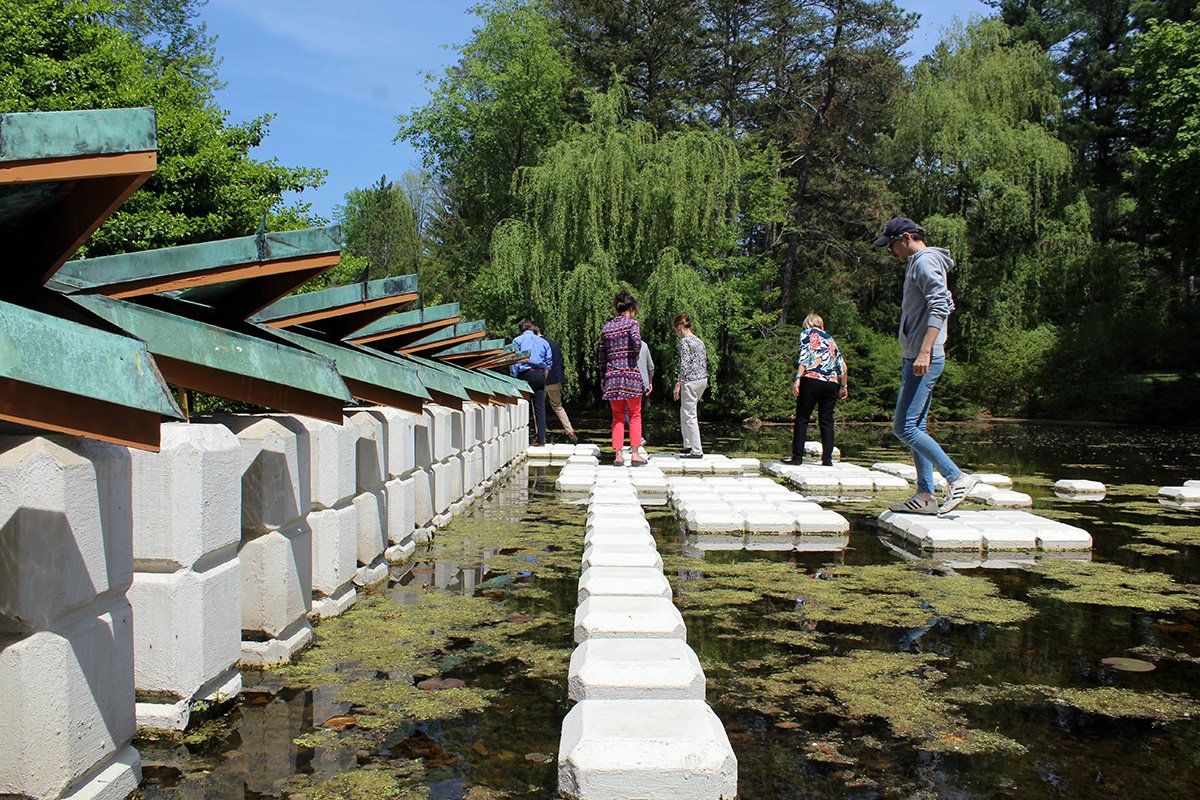
The block is everywhere in the house and on the grounds, and also extends the home into the pond via a scattering of pedestrian islands made from the same material, which elegantly collapse the border between the structure and the landscape. This is also a playful gesture, one that invites a visitor to explore, to wander, to hop among the stones—which, according to our guide, was typical of Dow's sensibility.
We couldn't take pictures in the house, but that spirit of adventure or escapade permeates inside, whether in the extreme compression and expansion of space from room to room, in long interior and exterior hallways, or the surprisingly vivid use of bright, saturated colors—pinks, purples, and greens that reference the lush flora outside—to draw one's attention up toward windows and ceilings that soar and fold.
The tour was an extraordinary experience, a rare opportunity to spend time in a truly beautiful, expansive, and well cared for place that was nonetheless human-scale, vivacious, warm, and idiosyncratic—an enlivening, playful, ever-shifting wonderland of ingenious and humane design.
Afterward, we embarked on a couple-hour interlude that basically consisted of us driving around Midland, spotting and pausing to admire more than a dozen modernist homes, and getting to know a friendly local named Laura who was initially suspicious of our interest but then proud to point out a few key streets where we could maximize our mid-century rubbernecking. Then we hit the road to Flint—just about halfway back home from Midland to Detroit.
RIVERBANK PARK
In the mid to late-1970s, Flint's fortunes were faltering. In an effort to revitalize the downtown, boosters and philanthropists organized the construction of a new downtown park to be designed by the firm of Lawrence Halprin (1916-2009), a Bay Area-landscape architect noted for his dynamic public spaces. Or so we learned from Cade Surface, a friend of a friend who has studied Riverbank Park extensively and has advocated for its preservation, and who happens to live just a few blocks away.
Cade took us all around the ten acre park, explaining that it embodies a key concern of Halprin's, who worked closely with his wife, the choreographer Anna Halprin: it is a space that invites people not simply to walk through it, but to dance—that is, to move through it in various and imaginative ways. In addition to the variety of perspectives it offers from which to watch other people, Riverbank Park, like the Dow House, encourages people to hop from space to space, to climb, to explore, to discover.
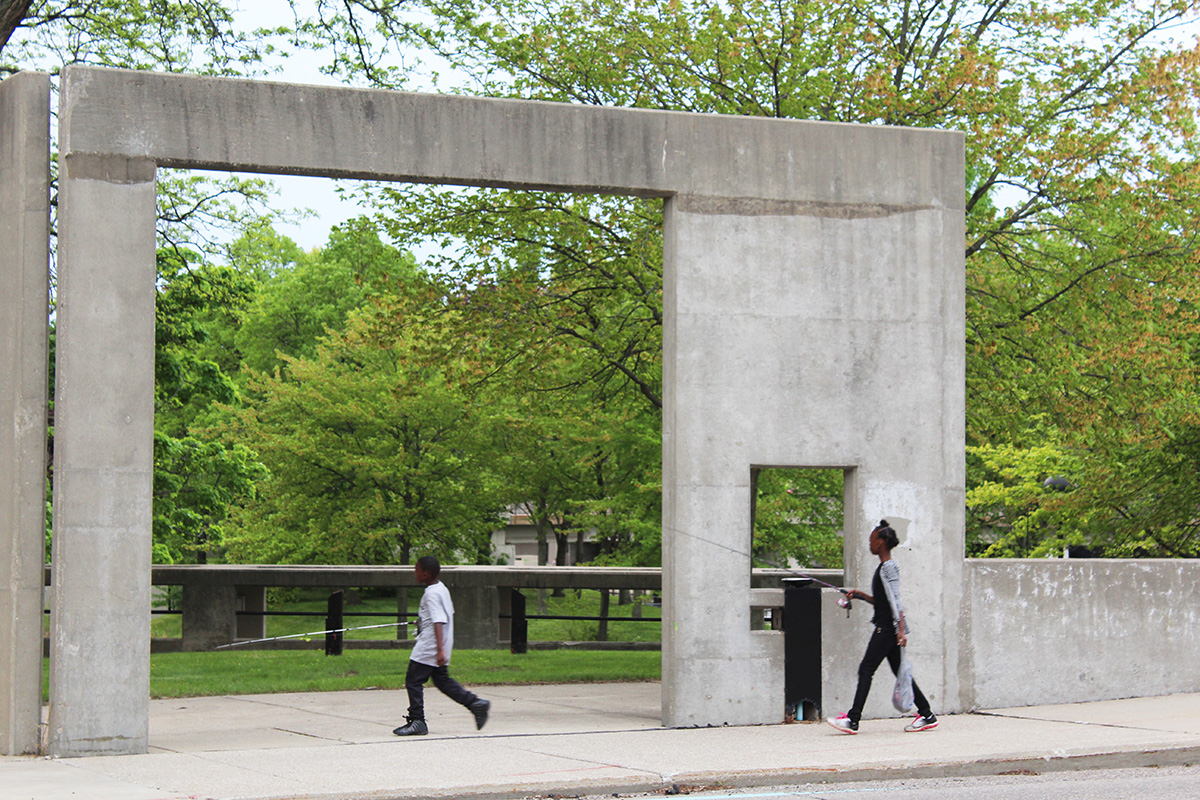
As you can see from the photos, Riverbank Park is made mostly of concrete, a material I'm personally very fond of (hence my interest in going there!). I'm one of those Brutalist weirdos who wants to tell you how soulful concrete is, how comforting and natural. I guess there is something about its sturdy matter-of-factness, or maybe its roots in the ancient world, that draws me to it. And there is, in fact, a classical quality to Riverbank Park, with its succession of outdoor rooms, its oculi and amphitheatre, its insistence on the ideal of the public.
But Riverbank Park was meant to be more than concrete geometric forms, grass, and trees; it was at one time permeated and enlivened by the Flint River itself, via a feat of engineering that involved the use of two nearby dams, an Archimedes screw, and an aqueduct, a system whereby water regularly coursed through the structure, cascading down steps and spouts and into pools and channels.
Photo of functioning Riverbank Park by Adam Pagnier
Currently, the park is dry, which gives it an austere and forlorn feeling. Cade explained that on advice from the federal government, Flint has gone about dismantling the two dams to minimize the risk of flooding downtown. The aqueduct and Archimedes screw have also been removed. It sounds like water can still be made to pass through the park piecemeal, but with effort, and only on special occasions.
The future of the park is uncertain. Our quick visit suggested that it is still used, but in addition to the malfunctioning water system, Riverbank Park does not seem to be well cared for (little wonder, in a city that, according to Cade, has just one full-time employee working for the entire park system). Cade said that one plan calls for most of it to be leveled and replaced with grassland. Along with other community members (including Emma Davis, a dance instructor at UM-Flint, who staged a community-driven performance there in 2014), he continues to advocate for its preservation as a place of local and national distinction, citing its singular character and the fact that numerous of Halprin's other spaces elsewhere in the country remain both vital and protected.
Part of what made our visit to the park somewhat sad is the profound disconnect between the soaring ambitions of its creators (one might say their hubris) and the earthbound economic reality of life in Flint. This was meant to be a grand place, and evidently it was, for a time—but grand places are expensive to maintain. How could Riverbank Park possibly have thrived after the successive social and economic crises that have rocked Flint's beleaguered citizens these last decades?
Even dry, still, skeletal, the park is a beautiful place. Yes, there is something integral missing, but it still feels sacred and surprising, like something from a dream. And in fact, as I fell asleep later that night in Detroit, I started dreaming that I was back there, under the sun, but that there was water rushing all around, down the steps, through the channels, spilling into basins, catching the light, splashing. The park was alive with water. It was a lovely vision of a rare and special place. I don't know if, after an hour and a half introductory visit, I have any right to advocate on behalf of the preservation of Riverbank Park, but I can't help but hope that I'll get a chance to experience that vision for real one day, and that many others will too.
I took a quick trip to Chicago last weekend to see some art! Though brief, it was full—a grateful getaway and a memorable aesthetic adventure.
The impetus was Tesseract, a new dance/video work created by video artist Charles Atlas and dancer-choreographers Silas Riener and Rashaun Mitchell. Tesseract was performed at Chicago's Museum of Contemporary Art (MCA)—and at the Walker Center in Minneapolis the week before—as part of "Common Time," a knockout Merce Cunningham exhibition currently on view at both institutions.
From Tesseract (2017) by Charles Atlas, Rashaun Mitchell, and Silas Riener. Photo courtesy of the MCA.
Atlas enjoyed a decades-long collaborative practice with Cunningham (1919-2009), documenting many of the legendary choreographer's dances, but also creating with him a host of experimental dance-for-camera works that radically reimagined the relationship between dance and video. Riener and Mitchell, meanwhile, were both acclaimed dancers in Cunningham's company near the end of its long run. (It disbanded, per the choreographer's instructions, upon his death.) So their new collaboration is a little "Merce Cunningham: The Next Generation," as Oren Goldenberg, a Detroit video artist and one of my travel buddies, put it. (Oren, who makes terrific dance-for-camera videos himself, is the subject of my next Essay'd essay, which will be out in a couple weeks.)
I was so curious to see what these three Mercists had made together. It turned out to be interesting, stylish, and ambitious but, I thought, ultimately a bit of a mess.
Oren's Star Trek reference ended up being pretty appropriate: Tesseract, which is half 3D dance video and half live performance with live video effects, has a decidedly sci-fi flavor. There were alien landscapes, alien scenarios, alien architecture, and (in a surprising and funny moment) an alien language; there was an especially beautiful dancer in shiny silver and black that looked and moved like an automaton; and, of course, there was the self-consciously hi-tech quality of the performance itself: not only the 3D dance film of the first half (a pretty exciting experience and, I thought, a delightful use of the medium), but also the live video effects of Act 2, which found a graceful (you might say dancerly) Steadicam-equipped videographer onstage with the dancers, whose likenesses were simultaneously projected onto a scrim and digitally manipulated by Atlas in real time.
From Tesseract (2017) by Charles Atlas, Rashaun Mitchell, and Silas Riener. Photo by Ray Felix, courtesy of the Walker Art Center.
There was, in the end, much to appreciate about Tesseract, especially in the 3D film, which cut between six different scenarios with markedly different sets, choreographies, costumes, and video effects. My favorite was a sort of Martian landscape, complete with a little Ray Bradbury building on the horizon, in which a group of orange-clad dancers with little geometric growths in their costumes were green-screened into the scene, collage-like, and proceeded to manipulate and move, slowly and exploratorily, through a series of larger shapes with which they were each paired. Subtle, mysterious, seductive stuff.
From Tesseract (2017) by Charles Atlas, Rashaun Mitchell, and Silas Riener. Production photo courtesy of the Walker Art Center.
Aside from a few decidedly over-the-top moments, I found myself mostly absorbed by the video, but I had a harder time getting into the live performance. It wasn't just that the on-stage videographer was distracting (he was); it was also that the video effects felt a little hokey and arbitrary, and that they reminded me of stronger, surer works that incorporated similar effects more successfully, like Lucinda Childs's 1979 Dance, which I saw on the same MCA stage in 2009 (and which I wrote about in this very blog!), and Cunningham's own Biped (1999), which made an indelible impression when I saw it in Ann Arbor all the way back in 2004. Both of those pieces include images of moving bodies projected onto a scrim in front of the dancers, but in each, the live dancing and the film/video effect are integrated into a coherent whole.
From Dance (2009 revival) by Lucinda Childs. Photo by Sally Cohn, courtesy of L'Obs.
Tesseract emulates both of those classic works, with the key difference that now the video is live. Does it need to be? It felt showy and a little contrived—something done because it could be done, rather than something undertaken to meaningfully advance the relationship between dancer and moving image. A stimulating challenge, no doubt, for the whole team of artists, but does it justify the distracting and distancing effect on the audience? I give the creative trio credit for much about Tesseract, which, in the end, I'm glad I saw (and which was, I ought to say, a robust and tentacled work, not easily summed up) but ultimately I felt that it didn't hang together. It lacked a center, and at the same time there was so much of it. (Do I sound like a cranky minimalist?) It seemed, as Oren remarked later, experimental in a way that connotes something still being worked out—something unfinished, in process.
More coherent, even in its overabundance, was "Common Time," the Cunningham exhibition that occupied the entire fourth floor of the MCA, and which we returned to the museum the next day to experience. Its theme is the dense network of creative collaborations and relationships that typified Cunningham's practice—and that brought dance into fruitful contact with the wider art world.
66-76-89 (1990) by Nam Jun Paik
Cunningham was an inveterate collaborator, working with a dizzying array of influential (largely New York-based) artists over his long career. They created sets, costumes, music, soundscapes and, in the case of Atlas and fellow video artist Nam Jun Paik, films and videos that augment, complement, complicate, and ultimately co-create Cunningham's work. (Cunningham maintained a remarkable degree of trust in his many collaborators, who were typically encouraged to pursue their own visions independently. Often, it was only in performance that all the elements would come together.) The exhibition overflows with these materials, including sets by Frank Stella, Robert Rauschenberg, and Robert Morris; costumes by Rei Kawakubo; scores and sound art by John Cage and Pauline Oliveros; and more Cunningham videos than I had ever hoped to see in one place. In addition, there are a number of standalone works by many of these artists, as well as ephemera from others with whom Cunningham did not actively collaborate, but who labored around the same time and place in their own influential and boundary-breaking ways, like Trisha Brown and Yoko Ono.
Autobiography (1968) by Robert Rauschenberg
"Common Time" is lavish, overwhelming, transcendent. It is at once a sprawling survey of some of the most groundbreaking American artists of the latter half of the 20th century, and a tightly focused examination of some of the circumstances and concerns that united them. (It's nuts to think that this is just half of a show, the other half filling the galleries of the Walker in Minneapolis.)
Most exciting, to me, was MC9, an unforgettable, immersive installation by Charles Atlas that reinforced my admiration for his work (any ambivalent impressions of Tesseract notwithstanding). Picture it: you enter a long, dark room, one of the MCA's impressive barrel vault galleries, and find yourself surrounded by an architecture of screens: monitors of varying sizes, many quite large, most sleek and flat, a few boxy; some mounted above your head, and others installed at body level. There is an incredible visual and aural commotion as nine channels featuring looping excerpts from 21 different Atlas/Cunningham dance-for-camera collaborations made over 40 years are simultaneously played (so that multiple screens display the same works at the same time, while different screens display others). Videos do not play back-to-back; edited between them are either a countdown, such as you'd see on an old film header (complete with penetrating, metronomic tones marking the descent), or else (literally) luminous, saturated color fields, a huge pink rectangle here, a green one there, that briefly catch and fill the eye, offering a respite from the relentless movement in the videos, and casting colored reflections on the bodies of the other spectators, who stand and take it all in or perambulate through the ad hoc promenade—agog, indifferent, or somewhere in between.
Installation view of MC9 (2012) by Charles Atlas
I got lost in that room, and might have stayed for hours. There was so much happening, so much to take in. It was a dreamy, mysterious space, both cavernous and intimate. There was an overlapping of sound—warm, ambient, and suddenly clear—and everywhere you looked, there were bodies in motion (in that crisp, awkward, balletic Cunningham style), bodies both historic and near-contemporary, in black and white and vivid color, life-size bodies that were imaginatively de- and re-contextualized, tracked up close by fluid, moving cameras, and depicted in images nested within images. A techno-temple to a titan, made of time. I took a brief video inside with my phone. It's just a phone video, nothing special (actually it's pretty bad), and it offers the barest glimpse of the thing itself, but I'm compelled to share it anyway:
I left "Common Time" and Chicago with a feeling of gratitude for having seen so much work by Cunningham and his cohort, and also with a sense of the weight and fullness of his long life. Cunningham died at 90, and had been working, collaborating, and documenting his efforts for nearly 60 of those years. I am inspired by this life: by the extent of his accomplishments, by his evidently vast capacity for friendship, and by his openness to time and chance and to moving forward with the world.
On the subject of time and aging, I should wrap up by mentioning that the MCA has another terrific exhibition up right now, "Eternal Youth," that would itself have been worth the trip from Detroit. It's a group show concerned with youth culture since the 1990s. I'm not going to go into it at length here, but suffice it to say that it's a sexy, funny, challenging, and queer-forward show, full of inventive, absorbing work by a diverse roster of artists both well-known and emerging. As such, it's a nice counterweight to the somewhat High Art seriousness of "Common Time," which might even seem a little stuffy, a little camp, by comparison.
* * *
Coda: While at the MCA, I was delighted to run into my friends Lesley and Megan from Detroit, who took me around "Eternal Youth" and showed me some of their favorite pieces. Here they are watching one of my favorites, a 20 minute video by Jumana Manna called Blessed Blessed Oblivion (2010), an earthy, engrossing exploration of the macho mystique of East Jerusalem thug culture. (You can watch it on Vimeo here.)
Back in June, I posted a photograph I took inside an installation at the Detroit Institute of Arts. The installation, a multimedia immersion in the 1968 Merce Cunningham dance RainForest, was part of Dance! American Art 1830-1960, a fine exhibition organized by the DIA that included mostly representations of dance in visual art, but also a handful of notable works related to dance as an art form itself.
RainForest, like many Cunningham dances, is notable in part for its incorporation of work by other prominent New York artists. The costumes, two examples of which were included in the exhibition, are by Jasper Johns, and its famous decor — silver, helium-filled Mylar pillows — were designed by Andy Warhol.
Recreations of those pillows were central to the installation, which was essentially a room, defined by a curtain, two walls, and a scrim. The pillows floated along the ceiling and billowed about the room, while a 1968 film of the dance was projected onto the scrim, but also through it, onto a solid wall, creating a mirror image.
The viewer could either consider the work from outside the room, looking at and through the scrim, or from inside, a gently chaotic, multilayered environment in which the predominant sense was of existing inside some version of the dance itself.
From either perspective, one was conscious of other people viewing/inhabiting the work, so a kind of voyeurism (watching people watching dance) became central to the experience of the installation. (The scrim, the gauzy mediator, at once allowed for this voyeurism and softened the tension that might otherwise arise from the experience of observing/being observed.)
I'm grateful to the DIA for organizing the installation, which provided the opportunity to experience RainForest in a way that was both vital and archival. It was an inventive installation and, I thought, well suited to Cunningham's work, in that it provided an essentially decentralized viewing experience. (Throughout his career, Cunningham resisted choreographing in ways that were uniform, at both the level of his dancers' individual bodies and in the relations between and among dancers, but also from the point of view of the audience, which, he recognized, were always in fact points of view, plural.)
This was not, after all, a reliable record of a dance, but something new and more complex that shifted between past and present: something that enveloped, even overwhelmed the spectator, whose eye zigzagged from the pillows above to the recorded dancers' spectral, larger-than-life bodies in motion, to the bodies of the people on the other side of the divide: walking, standing, sitting, watching.
This textural layering advanced an engaging and noteworthy approach to the presentation of historic dance works in a museum setting, outside of live performance, carrying RainForest forward in a sensitive and respectful way. It also made for a naturally inviting opportunity to take pictures, so after seeing the exhibition once, I returned, during lunch on a weekday, to shoot. For this opportunity, too, I thank the DIA, which encouraged museum-goers to take and share photos of the Dance exhibition — an unusual invitation, as far as special exhibitions at major American art museums go, and a nice example of the DIA's ongoing commitment to accessibility.
It's unusual for me to be in the museum on a weekday afternoon. I was surprised by how many people were there, and struck by how many of those people were seniors. It was an unexpectedly poignant experience, watching elderly people, many of whom moved slowly around the museum with the help of wheelchairs and walkers, absorbed, for a time, in the breathless, exhilarating movement of the dancers. Another layer: unpredictable and unintended, but resonant, nonetheless.
I spent some time today shooting inside the DIA's immersive installation inspired by the 1968 Merce Cunningham dance RainForest, part of the terrific exhibition Dance! American Art 1830-1960 (ends this weekend!).
I got some pretty exciting shots and will post a handful of them, along with some thoughts, in the next couple days, but for now, here's my favorite -- a fleeting visitation by the ghost of Merce (1919-2009) himself:
Last week I hosted LEAP NIGHT, a screening of seven short dance-for-camera films at Play House in Detroit. Play House, developed by Power House Productions, is the home of experimental performance group The Hinterlands, who invited me to curate a selection of historic dance films. (Well, six are historic, and one is a more recent, local production.)
It was so great. Great turn out (about 30 people showed up, just enough to fill the room), great energy, great opportunity. My pal Sarah Rose Sharp published a really nice write-up about it in KnightArts.
As I was preparing the program, I couldn't shake the feeling that I ought to write something about what I was showing, hence the following notes, comprised of a brief paragraph about each film, as well as a collage by the one and only Michel Francois Soucisse!
(click images to enlarge)
(If you haven't seen any of the films, they're all available to watch for free somewhere online, whether Youtube, Vimeo, or Ubuweb.)
For six evenings in late February and early March 2015, dancer & choreographer Biba Bell performed It Never Really Happened (Part One) in her fifth floor, corner apartment in the Pavilion, a 1958 Mies van der Rohe high rise in Detroit's Lafayette Park.
Bell describes It Never Really Happened as a "triptych," a dance in three parts taking place in the same apartment in the winter, summer and fall of this year. Part One was a solo, Part Two will be a duet, Part Three an ensemble piece.
Part One featured a soundtrack curated by DJ Scott Zacharias as well as a performance by photographer and musician Nicola Kuperus, who played "the hostess."
Bell was born in 1976 in Sebastopol, California and earned a Ph.D. in performance studies from N.Y.U. this year. She first became interested in creating an intimate, site-specific performance that would explore the intersection of dance, domesticity and modern architecture when she encountered Buckminster Fuller's Dymaxion House at the Henry Ford Museum. But it is in Lafayette Park, the mid-century superblock just east of downtown Detroit, that the dance continues to take shape.
I have known Biba for about five years and have admired and written about some of her previous work in Detroit. After attending two performances of It Never Really Happened (Part One), I decided to interview her to learn more about the performance's development, execution, and many shades of meaning.
On the evening of March 23rd, I walked from my apartment in Lafayette Towers across Lafayette Plaisance to the Pavilion, where I joined her for a homemade dinner, a bottle of wine and two hours of conversation. What follows is an edited and illustrated transcript of our talk, divided into ten sections and preceded by a sketch of the performance for readers who did not have the chance to attend it.
I saw Modern Garage Movement (also known as MGM Grand) perform in Detroit for the first time in 2009. It was sheer luck, actually, since I’d never heard of them and had only learned about the performance from an overheard conversation at a cafe. Unsure what to expect, I showed up to a warehouse in Southwest Detroit, then in use as artist studios and a performance space by the 555 Gallery, and was directed to a huge, open room several floors up. It was the kind of space that you find scattered throughout Detroit: a gorgeous, creaking, post-industrial vastness, a bit decrepit but steadfastly built to last.
The atmosphere was disarmingly informal. Theatre chairs were arranged here and there, and the company’s three dancers chatted casually with the fifteen or twenty gradually arriving audience members. The dance began with just one dancer, lying on the floor. She spent several minutes there, gasping, heaving her torso, arching her back, and flopping her limbs heavily, dramatizing a profoundly disquieting sense of body horror. From my perspective, I couldn’t see her face, which reduced her form to something anonymous and animal.
The dance, Royce, evolved into a work of purposeful purposelessness, with the dancers at times stalking furiously around the confines of the space. Having been created over the course of a few weeks as a site-specific work, it also became a dance about the space. The dancers moved around the room’s numerous pillars in a way that emphasized the pillars as much as it did the dancers. During one especially breathtaking moment, all of the lights were turned off except those illuminating a single corner of the room. The dancing continued, now as a supporting, exclusively auditory phenomenon. (The dance had no recorded soundtrack, only the dancers’ footfalls and breathing, and the regular, rhythmic splash of passing cars driving through puddles.)
Royce was playful, too; at one point, the dancers offered the audience beer and bags of chips. At another, they started rolling objects in our direction: balls, industrial spools, tires. This level of audience acknowledgment and involvement is essential to MGM Grand’s work. Also essential is an experiential investigation of space, an interest in taking dances on the road and letting them change along the way, and a tendency to perform in unexpected places.
The company will be bringing its singular performance style to the Museum of Contemporary Art Detroit this Friday, July 15. They’re dancing Nut, a 2010 piece informed, in part, by the classic Motown female trio (and featuring Motown music, modified by MGM collaborator R. McNeill). Nut was conceived at MIT, developed in Detroit, and premiered in New York at The Kitchen. After Friday’s performance, it will continue to tour on the east and west coasts.
MGM Grand originated in San Francisco and its three choreographer-dancers, Biba Bell, Jmy Leary, and Piage Martin, live across the country. Bell currently lives in the Detroit enclave of Hamtramck, and I interviewed her after seeing a recent Detroit performanceshe choreographed as Urisov, a moniker used to identify her solo work, apart from MGM Grand. (Urisov is pronounced your eyes of, and is a reference to Part IV of Hymmnn, the concluding section of Allen Ginsberg’s long poem Kaddish).
That performance was at the 2:1 Gallery, a temporary sound art space in Detroit’s Eastern Market district. It included a dance (InGrain) during part of which the audience sat in the basement and listened to the dancers performing upstairs, as well as a sound piece (Four Corners) by Gregory Holm and Jeffrey Williams that included a vibrating tambura, a droning, electronically modified piano, and two singers vocalizing wordlessly into the rooms’ corners. I asked Bell about her distinct creative personae, her influences, and the approach MGM Grand takes toward making and performing dances.
(originally published 6/28/11 in KnightBlog)
We could hear the powerful, rhythmic sound of Biba Bell’s six-inch heels striking the floor above our heads before the dance even started. Around 50 people (a good turnout for an avant-garde dance and sound art performance on a Sunday night in Detroit) were all seated in the basement of the 2:1 Gallery, the new sound art laboratory in Eastern Market. People chatted, took pictures and wondered about the dense arrangement of folding chairs; where, exactly, were the dancers supposed to perform? Above us, over the din, the purposeful sound of heels stalking the gallery space from one end to the other signaled an answer. Bell, a choreographer and dancer performing under the moniker Urisov, descended the stairs and announced the performance was about to start. With that, the lights were dimmed and "InGrain" began — upstairs and out of sight.
(originally published 4/26/11 in KnightBlog)
Marcelyn Bennett-Carpenter's Turn (one of two installations on view in Hamtramck this month) closed last Saturday night. To mark the occasion, there was an improvisational dance and music performance inside 2739 Edwin, the gallery space that housed the installation (composed of hundreds of translucent, tensile bands strung from floor to ceiling).
Sketches of the Merce Cunningham Dance Company's performance at the Power Center in Ann Arbor, Feb. 18, 2011
The company performed two pieces: 1976's Squaregame, resurrected for this farewell tour, and 2003's Split Sides, a noted collaboration with the art rock bands Sigur Rós and Radiohead.
Squaregame
As the front curtain opened, it became clear that every other curtain on the stage was up, too, revealing in vivid light all that's usually obscured, backstage, during a performance: tall ladders, machinery, massive crates stacked five or six high, countless cords and dollies, wires and thick ropes. It was a rich visual cacophony, and the stage space seemed suddenly huge. After the dance began, there were moments when I stopped paying attention to the dancers and focused instead on the staggering landscape of things that surrounded them.
The dancers performed on a white square, bordered on two sides by astroturf. Their costumes were '70s rehearsal clothes in soft, muted colors. White cylindrical canvas bags, full but light, served as props and set decoration.
The movement quality in this dance was especially fragmented; individual body parts were especially articulate. It seemed to be a dance about joints. It's also a dance about watching, because frequently, dancers sat down, alone or in groups, to carefully watch the others.
Robert Swinston, the dancer who performed the solo originally danced by Cunningham, looked remarkably like the late choreographer, both in appearance and movement style. The effect was uncanny and disorienting, and I felt momentarily out of time.
The score, by Takehisa Kosugi, is better described as electronic sound art than music. It undulated and burbled, submitting sounds of the human voice to processes and modulations that resulted in a kind of globular, biological soup. I kept imagining the contractions of the dancers' muscles, and in extreme close-up, the movement of their and cells and blood. Finale: several dancers are running, and one takes a canvas bags and hurls it into the air directly above him. It soars; he catches it. Lights out.
Split Sides Cunningham, like his partner and collaborator, the composer John Cage, was known for using chance in the composition and performance of his dances. This piece, comprised of two different sections, has 32 possible permutations. On stage, before the performance, five rolls of a die determine the order of the two dances, as well as the two distinct costumes, set designs, lighting cues and scores. Seeing a live dance is a rare thing. Seeing any one of the 32 versions of this dance is rarer still.
We heard Sigur Rós' music first and Radiohead's second. Both bands fashioned relatively challenging soundscapes that respect Cunningham's avant garde musical legacy.
The Sigur Rós piece moved from poignant, tender warmth to sparse hesitation, and from that to a shrill, screeching feedback assault. It included minimalist music box textures, metronomic beeping, and delicate sounds produced by pairs of miked ballet shoes, which we could see being "played" in the pit. (To create a slow, scratchy breathing sound, a musician gently dragged a pair of violin bows across the shoes.)
The Radiohead score was more aggressive, difficult and dissonant. It's the one that might have caused a few people near us to get up and walk out. (I was glad to see that a Cunningham concert can still ruffle a few feathers.) It made extraordinary use of stereo, the sound swinging hugely from one side of the room to the other. It included (briefly) what I thought was the only false step of the night, a documentary-style recording of an ominous, ranting Christian man. This felt too specific, too obvious. (But as Michel pointed out later, the piece premiered when we were still under the righteous, heavy hand of Bush II, when such sounds probably had more power to chill.)
The biological imagery of Kosugi's Squaregame score was transferred to the costumes in Split Sides. Golden and deep pink in the first half of the performance, black and silver in the second, both sets of costumes featured expressionistic splatters and lines that traced like tree branches or veins. The silver and black costumes fit the dancers like a second skin, lending them a sort of metallic, extraterrestrial quality (only enhanced by their characteristically "unnatural" movements and an important, repeated gesture: craning their necks, they tilted their faces expectantly to the sky).
There was so much to see in this dance. Too much, in fact. Cunningham was known for quoting Einstein: "There are no fixed points in space." He applied this principle to his dancers, telling them that whichever way they happened to be facing was front, and constructing his staging so that it reflected a vision of "many centers." In doing so, he liberates the spectator from the pressure to see everything; since so many dancers are on stage doing so much at once, alone or in groups, seeing everything becomes physically impossible. I felt free, therefore, to spend whole minutes watching only two dancers after they suddenly came together and danced a smiling, joyful duet amid the controlled chaos of other moving bodies. For the same minutes, those two dancers must have only skirted the edges of another spectator's vision; this, in aggregate, is the kind of perceptual freedom that a Cunningham dance offers.
During the post-performance Q & A, Robert Swinston talked about the future of the dances, now that Cunningham has died & the company is disbanding. He said that there will be a small group of dancers who will be taught the dances and who will pass them on to other companies and later generations. I am in love with this absurdly romantic idea: a chosen fraternity of artist/athlete/disciples, dancing not to perform, but to remember.
Shortly after Split Sides began, the house lights came up, momentarily disorienting the audience. For no more than 20 or 30 seconds, we were nearly as illuminated as the dancers, who continued uninterrupted. I felt certain that this was intentional, but later learned that the lights had been inadvertently triggered, a mistake that was corrected for the next night's performance. How lucky to have been there for this extraordinary misstep, which couldn't have been better-suited to Cunningham's work. The choreographer spoke often of waking audiences rather than lulling or hypnotizing them, and the quality of the gradually brightening light, accompanied by the then-tender Sigur Rós music, was dawn-like. Chance was an integral part of Cunningham's work, and by chance alone, Split Sides echoed the meta-performative aspects of Squaregame. The accidental light compelled us to look away from the dancers and around at one another; it reminded usthat we were members of an audience, all watching the same dance, yet each, alone, watching our own.