Showing posts with label photography. Show all posts

Tuesday, May 22, 2018

Mid-Michigan modern

We recently ventured to Midland, two hours north of Detroit, to tour the Alden B. Dow Home & Studio, and to Flint, where we visited Lawrence Halprin's Riverbank Park. Both sites were recommended to us by friends, and both represent significant but perhaps underappreciated achievements in modernist design in Michigan. I'm grateful to have had the chance to get to know both of these developments, and to assess the startling contrasts between them.


ALDEN B. DOW HOME AND STUDIO

Alden Dow (1904-1983) was a son of Herbert Henry Dow, founder of Dow Chemicals, and the philanthropist Grace A. Dow. He was a prolific modern and organic architect (after Frank Lloyd Wright), leading the design of more than 500 buildings across the country. In Midland, in particular, his influence was profound—he designed dozens of residential, civic, and commercial buildings, and his promotion of modernism evidently attracted a number of other similarly-inclined architects to Midland, resulting in a remarkable preponderance of modernist structures in this curious, conservative company town.

Grace A. Dow Memorial Library, also designed by Dow (That fascia is made of glass! And was evidently just restored last year.)

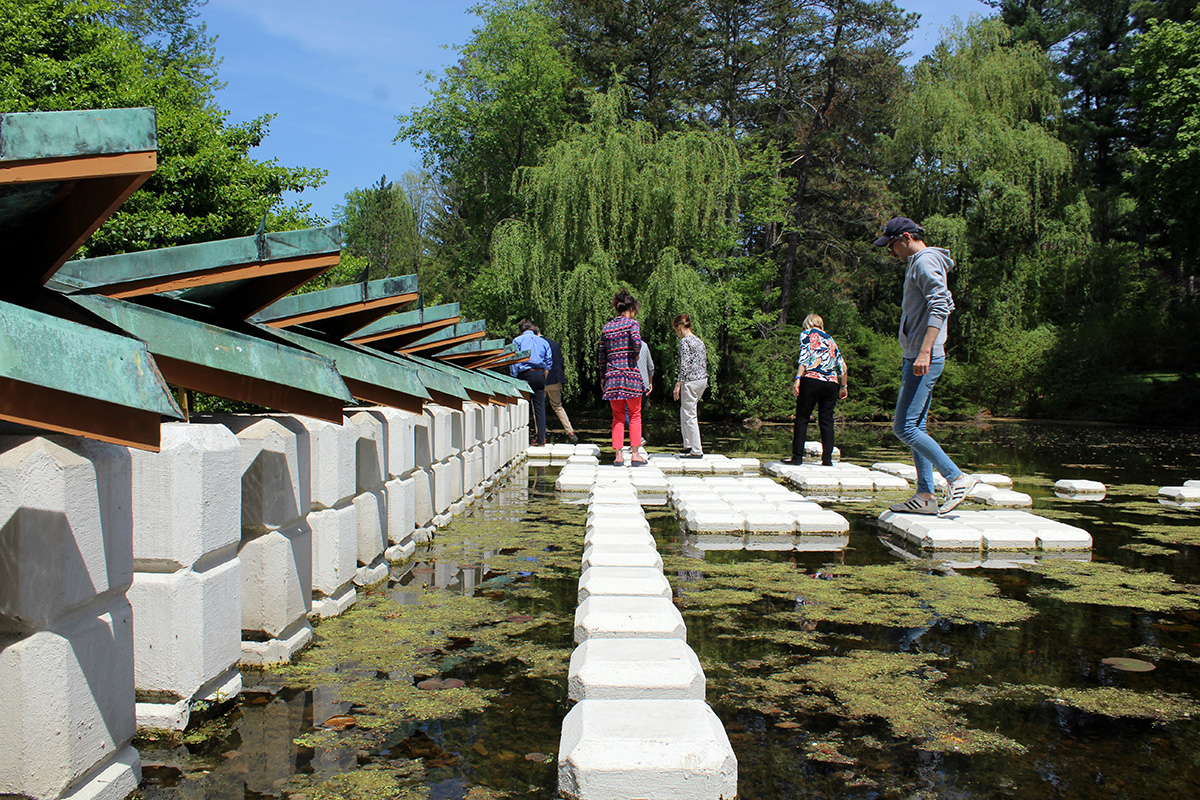
Dow designed his home and studio, nestled among extensive greenery and a manmade pond, between 1934 and 1941.


Seen from either its commercial entrance (above) or residential, the sprawling, low-slung building belies its astonishing 22,000 square feet. I learned from our tour guide that it is constructed primarily out of block made from recycled ash from Dow Chemical. The architect called this material "unit block," and it distinguishes many of his other residential buildings throughout Midland.


The block is everywhere in the house and on the grounds, and also extends the home into the pond via a scattering of pedestrian islands made from the same material, which elegantly collapse the border between the structure and the landscape. This is also a playful gesture, one that invites a visitor to explore, to wander, to hop among the stones—which, according to our guide, was typical of Dow's sensibility.




We couldn't take pictures in the house, but that spirit of adventure or escapade permeates inside, whether in the extreme compression and expansion of space from room to room, in long interior and exterior hallways, or the surprisingly vivid use of bright, saturated colors—pinks, purples, and greens that reference the lush flora outside—to draw one's attention up toward windows and ceilings that soar and fold.


The tour was an extraordinary experience, a rare opportunity to spend time in a truly beautiful, expansive, and well cared for place that was nonetheless human-scale, vivacious, warm, and idiosyncratic—an enlivening, playful, ever-shifting wonderland of ingenious and humane design.

Afterward, we embarked on a couple-hour interlude that basically consisted of us driving around Midland, spotting and pausing to admire more than a dozen modernist homes, and getting to know a friendly local named Laura who was initially suspicious of our interest but then proud to point out a few key streets where we could maximize our mid-century rubbernecking. Then we hit the road to Flint—just about halfway back home from Midland to Detroit.

RIVERBANK PARK

In the mid to late-1970s, Flint's fortunes were faltering. In an effort to revitalize the downtown, boosters and philanthropists organized the construction of a new downtown park to be designed by the firm of Lawrence Halprin (1916-2009), a Bay Area-landscape architect noted for his dynamic public spaces. Or so we learned from Cade Surface, a friend of a friend who has studied Riverbank Park extensively and has advocated for its preservation, and who happens to live just a few blocks away.


Cade took us all around the ten acre park, explaining that it embodies a key concern of Halprin's, who worked closely with his wife, the choreographer Anna Halprin: it is a space that invites people not simply to walk through it, but to dance—that is, to move through it in various and imaginative ways. In addition to the variety of perspectives it offers from which to watch other people, Riverbank Park, like the Dow House, encourages people to hop from space to space, to climb, to explore, to discover.


As you can see from the photos, Riverbank Park is made mostly of concrete, a material I'm personally very fond of (hence my interest in going there!). I'm one of those Brutalist weirdos who wants to tell you how soulful concrete is, how comforting and natural. I guess there is something about its sturdy matter-of-factness, or maybe its roots in the ancient world, that draws me to it. And there is, in fact, a classical quality to Riverbank Park, with its succession of outdoor rooms, its oculi and amphitheatre, its insistence on the ideal of the public.


But Riverbank Park was meant to be more than concrete geometric forms, grass, and trees; it was at one time permeated and enlivened by the Flint River itself, via a feat of engineering that involved the use of two nearby dams, an Archimedes screw, and an aqueduct, a system whereby water regularly coursed through the structure, cascading down steps and spouts and into pools and channels.

Photo of functioning Riverbank Park by Adam Pagnier

Currently, the park is dry, which gives it an austere and forlorn feeling. Cade explained that on advice from the federal government, Flint has gone about dismantling the two dams to minimize the risk of flooding downtown. The aqueduct and Archimedes screw have also been removed. It sounds like water can still be made to pass through the park piecemeal, but with effort, and only on special occasions.


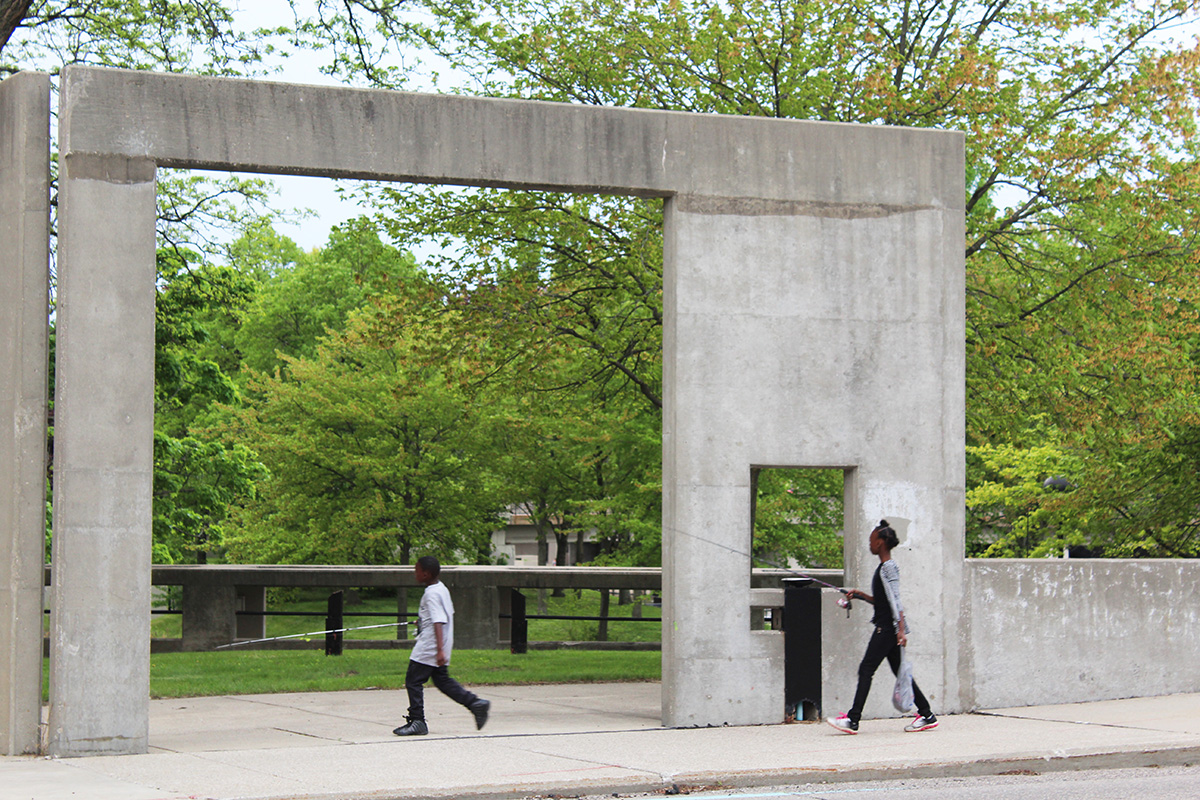


The future of the park is uncertain. Our quick visit suggested that it is still used, but in addition to the malfunctioning water system, Riverbank Park does not seem to be well cared for (little wonder, in a city that, according to Cade, has just one full-time employee working for the entire park system). Cade said that one plan calls for most of it to be leveled and replaced with grassland. Along with other community members (including Emma Davis, a dance instructor at UM-Flint, who staged a community-driven performance there in 2014), he continues to advocate for its preservation as a place of local and national distinction, citing its singular character and the fact that numerous of Halprin's other spaces elsewhere in the country remain both vital and protected.

Part of what made our visit to the park somewhat sad is the profound disconnect between the soaring ambitions of its creators (one might say their hubris) and the earthbound economic reality of life in Flint. This was meant to be a grand place, and evidently it was, for a time—but grand places are expensive to maintain. How could Riverbank Park possibly have thrived after the successive social and economic crises that have rocked Flint's beleaguered citizens these last decades?

Even dry, still, skeletal, the park is a beautiful place. Yes, there is something integral missing, but it still feels sacred and surprising, like something from a dream. And in fact, as I fell asleep later that night in Detroit, I started dreaming that I was back there, under the sun, but that there was water rushing all around, down the steps, through the channels, spilling into basins, catching the light, splashing. The park was alive with water. It was a lovely vision of a rare and special place. I don't know if, after an hour and a half introductory visit, I have any right to advocate on behalf of the preservation of Riverbank Park, but I can't help but hope that I'll get a chance to experience that vision for real one day, and that many others will too. 


Saturday, November 26, 2016

Rubello in motion

I recently visited the artist David Rubello at his home and studio in Ray, Michigan, a small, rural town about 40 miles northeast of Detroit, where he lives with his wife Mary, who is also an artist.

Self-portrait by David Rubello, early 1990s

I got to know Rubello (b. 1935) a couple years ago, after I became obsessed with his 1973 mural Color Cubes, a piece of downtown public art I loved that was lost in 2014. Since then, I have come to appreciate him as an astonishingly gifted, learned, and prolific visual artist, whose expansive body of work bears witness to an inspiring practice of perpetual forward motion.

In Rubello's home: antique Sicilian marionettes and six of his dimensional paintings from the early 2000s

Rubello is an under-appreciated modern artist — an American master, I'd venture, whose prodigious output in multiple media ought to be well-known internationally, but who has operated largely under the radar these last decades. Nonetheless, I can't shake the sense that his substantial and varied body of work is ripe for discovery by a wider contemporary audience.

I had a few reasons to visit him recently: I wanted to check out his recently reorganized studio, check in on one of his current projects (more on that later, but here's a teaser: there's a new downtown mural coming!), and to see some of his photograms, "cameraless photographs" that are made by arranging objects on photo paper before exposing the paper to light.

Photogram by Laszlo Moholy-Nagy, 1926

The photogram was popularized by the Hungarian artist Laszlo Moholy-Nagy, whose career retrospective I saw last summer at the Guggenheim. I'd mentioned to Rubello how alluring I'd found Moholy's early 20th century photograms, and he surprised me by responding that he'd made a number of them himself in the 1990s.


He showed me several dozen of these works, which he calls "New Life Forms," during my recent visit. Whereas Moholy made use of a remarkable variety of objects to produce his photograms (including his own hands and even his face), Rubello restricted himself to either an aluminum form of his own construction or, much more often, different kinds of paper, which he folded, sometimes cut, and carefully arranged on top of the photo paper in his darkroom.

Ganz by David Rubello, early 1990s

In their recursive, abstract revelry, hard edges, and play with depth and light, the resulting forms are essential Rubello. But in their delicate, sensitive grayscale, they're something of a revelation.

Septun by David Rubello, early 1990s

Rubello is, after all, an artist to whom pure color is more than a tool, but a subject in and of itself. He's been concerned for decades with how different color fields appear, feel, & interact with each other, and with reflected color, whereby vivid colors are cast onto white surfaces:

Detail of a Rubello sculpture comprised of painted panels

Detail, same piece, from behind, showing the reflected color effect

When we made it out to his studio, there were more surprises in store, starting with a new painting that's part of an ongoing series exploring the use of color to suggest movement and dimensionality.


Since I've come to think of him as a purely abstract artist, when he showed me a handful of watercolors from the early '70s, I was struck by their transitional nature, hovering as they do between abstraction and representation.


There are a number of sizable paintings stored in his studio, some as big as 4' x 8'. Most of them are purely abstract, but one, a work from the late 1970s that was inspired by a pre-Renaissance crucifixion painting he'd seen in Italy, has figures in it!


When I remarked on this, Rubello pulled out some of his earliest works on paper, illustrations made in the 1950s after he pursued studies at both Cass Tech High School and the School of the Arts and Crafts Society of Detroit (now the College for Creative Studies).


These sixty-year-old works, the last we looked at together, are evidence of a young artist's powerful raw talent. While they're confident, subtle, and painstakingly rendered, there's little evidence in their straightforward style of the rigorous, experimental abstraction that would follow. As such, they offer remarkable insight into Rubello's ever-evolving trajectory, revealing just how far he's come in order to come into his own.

Thursday, October 20, 2011

Detroit: now with people in it!

Gheorghina, Chadsey High School, Detroit, Dawoud Bey, 2003, chromogenic print. Detroit Institute of Arts
(originally published 10/20/11 in Bad At Sports)

For decades, Detroit has performed a facile and impoverished symbolic role in our regional and national consciousness. You know what the city represents almost by instinct: abandonment, danger, the slow yet violent death of once-mighty American industry — the death, even, of the American city.

The proliferation of this looming, limiting symbolism has been accelerated, in the last decade, by advances in digital photography technology and online connectedness, which have made exhibiting photographers of us all. Amateurs and professionals alike come from all over to photograph Detroit’s ruins (and then share them with their social networks). These crumbling structures are astonishing, when you’re not used to them (and even, sometimes, when you are). They’re hulking, haunting, impossible, darkly transcendent. Photographed, they have real power as memento mori. A “unique glimpse into the sublime, where time seems suspended and the glory of a civilization now past has taken hold of the onlooker” motivates the taking of such pictures, according to Detroit Institute of Arts photography curator Nancy Barr.

But, of course, these photos are contentious. They typify the “predatory side of photography” that Susan Sontag wrote about in 1977 in On Photography. (“The photographer both loots and preserves, denounces and consecrates.”) They’re touristy, superficial, embarrassing; more to the point, they nakedly dramatize the power dynamics that sustain a society in which some people are born and live among ruins and others can swoop in, photograph them, and return to their lives of material comfort.

And they keep us cornered, these photos. “This is what you are,” they say blandly to a city that is tired of getting shit on by hostile outsiders. They come to define us, to those who don’t know our warmth and industriousness.

But things are changing. Thanks in part to the same connecting technologies and tendencies that encourage the proliferation of ruin porn, new and expanding narratives about Detroit are being successfully disseminated alongside the old ones. Yes, we’re post-industrial; yes, we’re poverty-stricken; yes, we’ve got all these decrepit buildings to deal with; yes, yes, yes.

But! There are people here. All kinds of people, in fact. People who are struggling, yes, but also people who are choosing to live differently. People who’ve lived here all their lives and people who come from far away. People who are finding new ways to support one another. They’re designing and creating viable public spaces, they’re farming the land, they’re learning to live in ways that are not inherently hierarchical, they’re making art out of the rubble. Is all this new? No. But for the first time in a long time, it’s news. In a surprising turn, the people in this city are starting to compete with violent death and empty buildings as objects of outsider interest.

Detroit Revealed, the new exhibition at the DIA that showcases ten years of Detroit photography by eight different photographers (four local, four not), reflects Detroit-as-symbol in the expected ways (“predictable,” the exhibition text readily admits), but also in some of these newly-understood ways. It’s notable because it reflects a tentative understanding of Detroit’s real urban complexity, a complexity that has lately eluded it in the popular consciousness.

Friday, July 29, 2011

"In Bloom" at the Susanne Hilberry gallery


(originally published 7/29/11 in KnightBlog)

You’ll find no flowers when you visit the Susanne Hilberry Gallery to see “In Bloom,” the four-person show on view there until August 6. Not real ones, anyway. There’s a Styrofoam box full of artificial flowers, watered fruitlessly by a half-hearted burble. And there’s an abundant sense of growing and blooming in much of the rest of the work. But almost none of it is natural growth; the work resolutely inhabits the realm of the artificial, only peeking out to see the natural world from inside material culture. Comprised largely of detritus from the consumerist machine that has come to constitute our environment, the work can only ever refer to nature, though natural ghosts insistently haunt the periphery.

Art referring to nature, of course, is nothing new. What is relatively new, the work suggests, is how very natural the artificial has become. In a 2008 reviewof work by Ivin Ballen, an artist in the show whose pieces include paintedtrompe l’oeil representations of duct tape and plastic bags, Lynn Crawfordmakes a surprising comparison to the mid-19th century landscapes of theHudson River School. But it makes sense; those artists represented the natural environment as they experienced it. For Ballen, today, duct tape and garbage bags are the environment.

Friday, February 11, 2011

Moments of being: Andre Kertesz at the DIA


(originally published 3/11/11 in KnightBlog)

If you haven’t been to the Detroit Institute of Arts’ photography gallery lately, stop by and check out the current show, An Intuitive Eye: André Kertész Photographs 1914-1969. This generous exhibition of elegant black and white images traces the influential modernist’s career from Hungary, where it began, to Paris in 1925 and New York in 1936. The work from each period is distinct, but consistently displays an extraordinary sensitivity to shadow, light and geometry, a sensitivity that DIA associate curator Nancy Barr describes as “unique in [Kertész’s] time.”

As one of the first street photographers, Kertész captured spontaneous moments of urban activity while emphasizing the lines, shapes, planes and textures that such moments consist of (visually, anyway). The show features many of these remarkable, candid shots, but also draws attention to his still life and portrait work, which is no less riveting.