Showing posts with label performance. Show all posts

Sunday, October 3, 2021

Blissed

It's been eight days since the Detroit production of Bliss, the titanic performance installation staged by Michigan Opera Theatre in the ruins of the old Michigan Theatre, and here I am still bobbing along like a lifeboat in its wake.
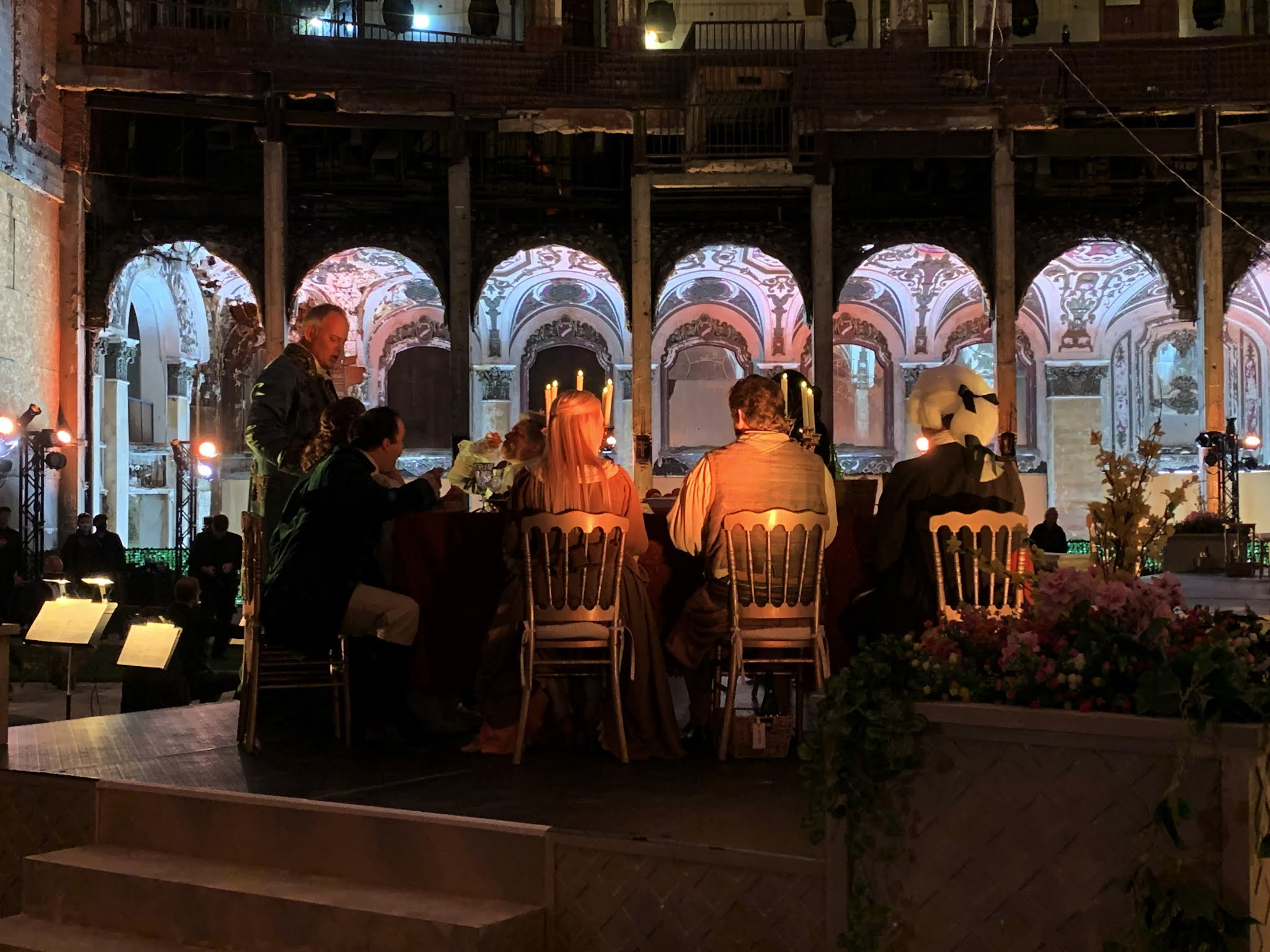
Somehow I did not expect this. Going into it, I did have the feeling that I would probably love the experience of attending Bliss, a twelve hour opera event originally conceived by Icelandic artist Ragnar Kjartansson, in which three sublime minutes of music from the conclusion of Mozart's Marriage of Figaro—the moments when a count publicly asks his wife's forgiveness for attempting to seduce a servant and, much to their community's joy, she grants itare repeated over and over and over again.

If this makes the performance sound static or dull, it wasn't. The staging of each three minute cycle varied, subtly or dramatically, from the one before it; the light changed entirely as day turned to night; and sometimes there was dancing. The audience, meanwhile, was invited to come, go, and move around as we pleased. With audience and production ever in flux, there was a sense of constant renewal and change against the perpetual backdrop of the music.

Corey McKern as Count Almaviva. He only took two short breaks in twelve hours!

I expected to love all this because one the roles I am happiest to play in life is that of audience member. I am, let's face it, a performance junkie, and a complete sucker for so-called "durational" performance experiences (experiments where live, time-based art and staggering endurance meet), not to mention a wannabe opera queen and fairly avid explorer of Detroit's ruins, back in the day. This one, in other words, had Matthew Piper written all over it. It's the kind of thing I would have traveled to see—only I didn't have to.

And I did love being there. It was the tops—one of my all time great performances. I was immersed in Bliss for about five hours, all told, with a short break for a walk around the block and a longer one for dinner and more art (during which I nevertheless felt tugged, insistently, back to the theatre), and my experience was everything I hoped it would be: overwhelming, surprising, dreamlike, joyful. Ecstatic. Intoxicating.


But I didn't expect it to create the conditions for these feelings—this bliss—to persist, to reverberate, to be carried with me out of that vast, magic chamber into the corners of daily life, for days. In the time since Bliss, I have found myself dancing my way through public places and bursting into laughter for no particular reason. When I return to the production in my memory, as I often do, I can’t help but feel an immediate onset of peace. When I take a few minutes to re-watch the short videos I made, or listen to a recording of that soaring music again, I sense a sudden thrill, a surge of energy and emotion that felt, the first couple times I experienced it, surprising in its force.

More generally, I have felt, in ways that aren't necessarily easy to put into words, more at ease, more relaxed, more inspired, more myself. Less clenched. I have the sense of having unburdened a certain amount of weight I've been carrying this summer, this year, this pandemic. I'm operating from some new baseline of contentment. This can't last, of course, and every day I can feel the distance between that time and the time I'm in grow a little wider, but for now, I'm living in it, I'm looking at it, and I'm feeling profoundly grateful for whatever on earth Bliss did to my brain. (Honestly, someone should do a study.)

But so what? you might reasonably ask. So what if I'm over here feeling blissed? 

Well, I've been thinking about that. By making the decision to stage Bliss at the Michigan Theatre, one of Detroit's most well-known ruins—a once glorious palace that was infamously converted into a parking garage in the 1970s—MOT's new artistic director Yuval Sharon had a stroke of genius that I think accounts for some of the work's peculiar punch. This was not merely an exciting, dramatic, eminently Instagrammable backdrop for Bliss (though it was that, too); it was an opportunity to place the production's theme of forgiveness in a particular local context to profound effect.

In his brief but trenchant program notes, Sharon notes that the repetition of those three minutes is Kjartansson's way of suggesting that forgiveness is itself a durational experience: "a marathon, not a sprint." A process, not an event.

By staging his Bliss in the Michigan Theatre, Sharon granted Detroiters and suburbanites alike an opportunity to embrace one of the City's ruins in a way that no major arts organization has done here, as far as I'm aware—to inhabit it, to look right at it, to be in it, to wonder in it, not to avoid it or shake our heads at it, or even objectify it in that way that ruin porn is criticized for doing. The audience became part of that place, or rather we were given the opportunity to accept that we are a part of it, and that it is a part of us.

We were invited, in other words, to engage in a process of forgiving the City for its failures, of which the Michigan Theatre is a particularly vivid example.


On one hand, there is a civic dimension to this, in which the individual audience member could be said to have been invited to forgive "the City," writ large, for the grievous sins the Michigan Theatre represents—racist disinvestment, decline, and disrespect, auto-mania, forgetfulness, self-sabotage...the list goes on. 

But then again, as several wise Detroiters in my life have asked to powerful rhetorical effect, who is the City if you're not the City?

There is a deeper level here, where the City is not some historical abstraction but the people in attendance. I think Detroit's Bliss gave audience members the opportunity to forgive ourselves; that's why I've been floating through my week. That's why it matters.

Every day today, we are bombarded with evidence of our failures. On social media, in the news, we are confronted with an endless litany, a barrage of failure: our failure to protect the natural world we fail to remember we're part of, our failure to get along, our failure to protect and care for the most vulnerable among us, to respect one another, to connect with and learn from each other, to separate fact from fantasy.... We live in a world of failure now. It seems inescapable.

In Detroit, perhaps more than in many other places, we are somewhat used to inhabiting a landscape of failure. We cannot help but be reminded of our collective carelessness every time we leave the house, by every closed library and abandoned school, every gutted, treeless expanse, every parking lot where a building used to be, every residential neighborhood situated near a toxic industrial facility or ripped in two by concrete conduits for cars, and the reality is that daily life in this nearly unremitting chaos takes a psychic toll. How could it not?

Bliss offered its audience no solutions to our endemic problems. Instead, it gave us, briefly but penetratingly, a large measure of redemption and grace that we desperately need in our ruined, wasted world. This is akin to the kind of regenerative grace we might otherwise find in nature or in community, compressed by art's magic into twelve hours that gestured toward the eternal. Through its repetition, its beauty, its sensitive siting and its scale, Bliss gave us a useful tool we could carry with us and share, a device for remembering and accessing peace when we need it. And it left us rich with the real fruits of forgiveness: a shift in perception, a new frame of reference, a chance to begin again.

Wednesday, January 17, 2018

Making rock music with Kathy Leisen

Oh Detroit, what have we done to deserve Kathy Leisen?

If you don't know Kathy, she's an artist, musician and singer with a voice like a smoldering, late night campfire beneath a big, starry sky somewhere out West, with some ragged clouds just starting to roll in and drizzle, but it's OK because you're with your friends and you've had a little whisky and you just spent the whole day outside. Her band Soft Location, with their mellow, slow-burn rock tunes crowned by Kathy's aching lyrics of love and longing, is a Detroit essential. Put on a Soft Location record and time slows; you drift a little. You melt. Here, listen:


Kathy also happens to be disarmingly graceful, forthright, and generous of spirit. I will perhaps forever associate her with the peaceful, matter-of-fact good vibes of the Detroit art community. She's one of the first people I met, seven or so years ago, when I started writing about Detroit art with any semblance of seriousness, and I won't soon forget the kindness and openness with which she welcomed me (nervous, unsteady) into the little sound art gallery in Eastern Market where she was noodling on an acoustic guitar.

Last weekend, she amply demonstrated that welcoming spirit in "Harmony By Any Means Necessary," an intimate performance at Popps Packing, the Hamtramck home, studio, and artspace of artists Graem Whyte and Faina Lerman. The concert was part of the Lounge of Saturn, an ongoing exhibition and performance series at Popps featuring work by a dizzying array of Detroit artists.

Popps Packing

For the occasion, Kathy donned a plain, billowy garment that her friend, the artist Chad Wentzel, created, a sort of giant apron that makes her one with her keyboard. ("I feel like I'm getting ready to go into surgery," she joked as she slipped into it. Chad told me that his ambition is to make a room-sized version of this piece, an environment, basically, that would join Kathy and her keyboard with the audience, a la James Lee Byars, maybe. Sounds like fun.)

As she set up the keyboard, Kathy placed five or six stones, maybe 2-5 inches long each, along the top of it, as well as a couple rolls of masking tape, and told the assembled company that she needed some help with the performance—or the game, as she put it. ("Art should be fun, shouldn't it?") The idea was that she would start playing, and then we would commence to shape the music together, with each audience member encouraged to walk up at any time and place a stone on a key, or group of keys, or else tape down a particular key. As the tones shifted, Kathy would correspondingly modulate the tone of her voice, producing a unique, improvised composition, co-created on the spot.


I've seen Kathy use her stones in a more straightforward solo performance recently, at the Shells record release party at Trinosophes, and it's a subtle but powerful gesture. Visually, tactilely, the stones carry a certain weight. They're of course such natural objects, freighted with idiosyncratic meanings about their (be)holder's connection to the natural world, about childhood exploration, ancient beginnings and environmental degradation. There is something fruitful, dialectical, about the relationship between the stones—with their utter simplicity, their mute, compact, essential rock-ness—and the keyboard, the big sound machine, hard-angled and complexly engineered. Their union (their reconciliation) could be gimmicky or precious, but it's not; instead, it's unexpected, a little whimsical, and quite elegant.

The sound, meanwhile, is notably...visual. There's the background, the pure, hard tones of the keyboard, which are minimal, even, unambiguous, and insistent: a drone. (A plane.) And the foreground: Kathy's voice, reverb-ed and echoing, freeform, soft, shifting, and abstract. (There are lyrics there, but they're fuzzy and indistinct—mostly you can make out an "I" here, a "you" there—all, perhaps, you need to know.)

With participation, of course, there is much more: you hold the rocks in your hands. You make choices, informed or not. (Kathy is definitely not worried about whether or not participants "know" music, which is in itself pretty incredible.) You perform the ritual; you walk up and make an offering, to...what? The god of music, maybe, or to Kathy, or to the Earth itself. And you do it in concert, with strangers, perhaps, or with friends. You play (in more ways than one) and then enjoy the remarkable result: that voice, that sad, silver voice, ringing out over the tones that you've manifested, together.


"Harmony By Any Means Necessary" was all over pretty quickly. Just three distinct compositions, maybe 15 or 20 minutes in total, but what a gift: a precious opportunity, these days, to shake off the weight of things, the anxiety, the despair, the ceaseless chatter, and to make something that stands apart—something simple and still, sacred and shared.

Thursday, March 30, 2017

Keeping time with Merce Cunningham in Chicago

I took a quick trip to Chicago last weekend to see some art! Though brief, it was full—a grateful getaway and a memorable aesthetic adventure.

The impetus was Tesseract, a new dance/video work created by video artist Charles Atlas and dancer-choreographers Silas Riener and Rashaun Mitchell. Tesseract was performed at Chicago's Museum of Contemporary Art (MCA)—and at the Walker Center in Minneapolis the week before—as part of "Common Time," a knockout Merce Cunningham exhibition currently on view at both institutions.

From Tesseract (2017) by Charles Atlas, Rashaun Mitchell, and Silas Riener. Photo courtesy of the MCA.

Atlas enjoyed a decades-long collaborative practice with Cunningham (1919-2009), documenting many of the legendary choreographer's dances, but also creating with him a host of experimental dance-for-camera works that radically reimagined the relationship between dance and video. Riener and Mitchell, meanwhile, were both acclaimed dancers in Cunningham's company near the end of its long run. (It disbanded, per the choreographer's instructions, upon his death.) So their new collaboration is a little "Merce Cunningham: The Next Generation," as Oren Goldenberg, a Detroit video artist and one of my travel buddies, put it. (Oren, who makes terrific dance-for-camera videos himself, is the subject of my next Essay'd essay, which will be out in a couple weeks.)

I was so curious to see what these three Mercists had made together. It turned out to be interesting, stylish, and ambitious but, I thought, ultimately a bit of a mess.

Oren's Star Trek reference ended up being pretty appropriate: Tesseract, which is half 3D dance video and half live performance with live video effects, has a decidedly sci-fi flavor. There were alien landscapes, alien scenarios, alien architecture, and (in a surprising and funny moment) an alien language; there was an especially beautiful dancer in shiny silver and black that looked and moved like an automaton; and, of course, there was the self-consciously hi-tech quality of the performance itself: not only the 3D dance film of the first half (a pretty exciting experience and, I thought, a delightful use of the medium), but also the live video effects of Act 2, which found a graceful (you might say dancerly) Steadicam-equipped videographer onstage with the dancers, whose likenesses were simultaneously projected onto a scrim and digitally manipulated by Atlas in real time.

From Tesseract (2017) by Charles Atlas, Rashaun Mitchell, and Silas Riener. Photo by Ray Felix, courtesy of the Walker Art Center.

There was, in the end, much to appreciate about Tesseract, especially in the 3D film, which cut between six different scenarios with markedly different sets, choreographies, costumes, and video effects. My favorite was a sort of Martian landscape, complete with a little Ray Bradbury building on the horizon, in which a group of orange-clad dancers with little geometric growths in their costumes were green-screened into the scene, collage-like, and proceeded to manipulate and move, slowly and exploratorily, through a series of larger shapes with which they were each paired. Subtle, mysterious, seductive stuff.

From Tesseract (2017) by Charles Atlas, Rashaun Mitchell, and Silas Riener. Production photo courtesy of the Walker Art Center.

Aside from a few decidedly over-the-top moments, I found myself mostly absorbed by the video, but I had a harder time getting into the live performance. It wasn't just that the on-stage videographer was distracting (he was); it was also that the video effects felt a little hokey and arbitrary, and that they reminded me of stronger, surer works that incorporated similar effects more successfully, like Lucinda Childs's 1979 Dance, which I saw on the same MCA stage in 2009 (and which I wrote about in this very blog!), and Cunningham's own Biped (1999), which made an indelible impression when I saw it in Ann Arbor all the way back in 2004. Both of those pieces include images of moving bodies projected onto a scrim in front of the dancers, but in each, the live dancing and the film/video effect are integrated into a coherent whole.

From Dance (2009 revival) by Lucinda Childs. Photo by Sally Cohn, courtesy of L'Obs.

Tesseract emulates both of those classic works, with the key difference that now the video is live. Does it need to be? It felt showy and a little contrived—something done because it could be done, rather than something undertaken to meaningfully advance the relationship between dancer and moving image. A stimulating challenge, no doubt, for the whole team of artists, but does it justify the distracting and distancing effect on the audience? I give the creative trio credit for much about Tesseract, which, in the end, I'm glad I saw (and which was, I ought to say, a robust and tentacled work, not easily summed up) but ultimately I felt that it didn't hang together. It lacked a center, and at the same time there was so much of it. (Do I sound like a cranky minimalist?) It seemed, as Oren remarked later, experimental in a way that connotes something still being worked out—something unfinished, in process.

More coherent, even in its overabundance, was "Common Time," the Cunningham exhibition that occupied the entire fourth floor of the MCA, and which we returned to the museum the next day to experience. Its theme is the dense network of creative collaborations and relationships that typified Cunningham's practice—and that brought dance into fruitful contact with the wider art world.

66-76-89 (1990) by Nam Jun Paik

Cunningham was an inveterate collaborator, working with a dizzying array of influential (largely New York-based) artists over his long career. They created sets, costumes, music, soundscapes and, in the case of Atlas and fellow video artist Nam Jun Paik, films and videos that augment, complement, complicate, and ultimately co-create Cunningham's work. (Cunningham maintained a remarkable degree of trust in his many collaborators, who were typically encouraged to pursue their own visions independently. Often, it was only in performance that all the elements would come together.) The exhibition overflows with these materials, including sets by Frank Stella, Robert Rauschenberg, and Robert Morris; costumes by Rei Kawakubo; scores and sound art by John Cage and Pauline Oliveros; and more Cunningham videos than I had ever hoped to see in one place. In addition, there are a number of standalone works by many of these artists, as well as ephemera from others with whom Cunningham did not actively collaborate, but who labored around the same time and place in their own influential and boundary-breaking ways, like Trisha Brown and Yoko Ono.

Autobiography (1968) by Robert Rauschenberg

"Common Time" is lavish, overwhelming, transcendent. It is at once a sprawling survey of some of the most groundbreaking American artists of the latter half of the 20th century, and a tightly focused examination of some of the circumstances and concerns that united them. (It's nuts to think that this is just half of a show, the other half filling the galleries of the Walker in Minneapolis.)

Most exciting, to me, was MC9, an unforgettable, immersive installation by Charles Atlas that reinforced my admiration for his work (any ambivalent impressions of Tesseract notwithstanding). Picture it: you enter a long, dark room, one of the MCA's impressive barrel vault galleries, and find yourself surrounded by an architecture of screens: monitors of varying sizes, many quite large, most sleek and flat, a few boxy; some mounted above your head, and others installed at body level. There is an incredible visual and aural commotion as nine channels featuring looping excerpts from 21 different Atlas/Cunningham dance-for-camera collaborations made over 40 years are simultaneously played (so that multiple screens display the same works at the same time, while different screens display others). Videos do not play back-to-back; edited between them are either a countdown, such as you'd see on an old film header (complete with penetrating, metronomic tones marking the descent), or else (literally) luminous, saturated color fields, a huge pink rectangle here, a green one there, that briefly catch and fill the eye, offering a respite from the relentless movement in the videos, and casting colored reflections on the bodies of the other spectators, who stand and take it all in or perambulate through the ad hoc promenade—agog, indifferent, or somewhere in between.

Installation view of MC9 (2012) by Charles Atlas

I got lost in that room, and might have stayed for hours. There was so much happening, so much to take in. It was a dreamy, mysterious space, both cavernous and intimate. There was an overlapping of sound—warm, ambient, and suddenly clear—and everywhere you looked, there were bodies in motion (in that crisp, awkward, balletic Cunningham style), bodies both historic and near-contemporary, in black and white and vivid color, life-size bodies that were imaginatively de- and re-contextualized, tracked up close by fluid, moving cameras, and depicted in images nested within images. A techno-temple to a titan, made of time. I took a brief video inside with my phone. It's just a phone video, nothing special (actually it's pretty bad), and it offers the barest glimpse of the thing itself, but I'm compelled to share it anyway:


I left "Common Time" and Chicago with a feeling of gratitude for having seen so much work by Cunningham and his cohort, and also with a sense of the weight and fullness of his long life. Cunningham died at 90, and had been working, collaborating, and documenting his efforts for nearly 60 of those years. I am inspired by this life: by the extent of his accomplishments, by his evidently vast capacity for friendship, and by his openness to time and chance and to moving forward with the world.

On the subject of time and aging, I should wrap up by mentioning that the MCA has another terrific exhibition up right now, "Eternal Youth," that would itself have been worth the trip from Detroit. It's a group show concerned with youth culture since the 1990s. I'm not going to go into it at length here, but suffice it to say that it's a sexy, funny, challenging, and queer-forward show, full of inventive, absorbing work by a diverse roster of artists both well-known and emerging. As such, it's a nice counterweight to the somewhat High Art seriousness of "Common Time," which might even seem a little stuffy, a little camp, by comparison.

* * *

Coda: While at the MCA, I was delighted to run into my friends Lesley and Megan from Detroit, who took me around "Eternal Youth" and showed me some of their favorite pieces. Here they are watching one of my favorites, a 20 minute video by Jumana Manna called Blessed Blessed Oblivion (2010), an earthy, engrossing exploration of the macho mystique of East Jerusalem thug culture. (You can watch it on Vimeo here.)


Sunday, October 30, 2016

Inside "Rainforest" at the DIA

Back in June, I posted a photograph I took inside an installation at the Detroit Institute of Arts. The installation, a multimedia immersion in the 1968 Merce Cunningham dance RainForest, was part of Dance! American Art 1830-1960, a fine exhibition organized by the DIA that included mostly representations of dance in visual art, but also a handful of notable works related to dance as an art form itself.

RainForest, like many Cunningham dances, is notable in part for its incorporation of work by other prominent New York artists. The costumes, two examples of which were included in the exhibition, are by Jasper Johns, and its famous decor — silver, helium-filled Mylar pillows — were designed by Andy Warhol. 


Recreations of those pillows were central to the installation, which was essentially a room, defined by a curtain, two walls, and a scrim. The pillows floated along the ceiling and billowed about the room, while a 1968 film of the dance was projected onto the scrim, but also through it, onto a solid wall, creating a mirror image. 


The viewer could either consider the work from outside the room, looking at and through the scrim, or from inside, a gently chaotic, multilayered environment in which the predominant sense was of existing inside some version of the dance itself. 


From either perspective, one was conscious of other people viewing/inhabiting the work, so a kind of voyeurism (watching people watching dance) became central to the experience of the installation. (The scrim, the gauzy mediator, at once allowed for this voyeurism and softened the tension that might otherwise arise from the experience of observing/being observed.)


I'm grateful to the DIA for organizing the installation, which provided the opportunity to experience RainForest in a way that was both vital and archival. It was an inventive installation and, I thought, well suited to Cunningham's work, in that it provided an essentially decentralized viewing experience. (Throughout his career, Cunningham resisted choreographing in ways that were uniform, at both the level of his dancers' individual bodies and in the relations between and among dancers, but also from the point of view of the audience, which, he recognized, were always in fact points of view, plural.)


This was not, after all, a reliable record of a dance, but something new and more complex that shifted between past and present: something that enveloped, even overwhelmed the spectator, whose eye zigzagged from the pillows above to the recorded dancers' spectral, larger-than-life bodies in motion, to the bodies of the people on the other side of the divide: walking, standing, sitting, watching. 

This textural layering advanced an engaging and noteworthy approach to the presentation of historic dance works in a museum setting, outside of live performance, carrying RainForest forward in a sensitive and respectful way. It also made for a naturally inviting opportunity to take pictures, so after seeing the exhibition once, I returned, during lunch on a weekday, to shoot. For this opportunity, too, I thank the DIA, which encouraged museum-goers to take and share photos of the Dance exhibition — an unusual invitation, as far as special exhibitions at major American art museums go, and a nice example of the DIA's ongoing commitment to accessibility.


It's unusual for me to be in the museum on a weekday afternoon. I was surprised by how many people were there, and struck by how many of those people were seniors. It was an unexpectedly poignant experience, watching elderly people, many of whom moved slowly around the museum with the help of wheelchairs and walkers, absorbed, for a time, in the breathless, exhilarating movement of the dancers. Another layer: unpredictable and unintended, but resonant, nonetheless.

Thursday, June 9, 2016

Visitation

I spent some time today shooting inside the DIA's immersive installation inspired by the 1968 Merce Cunningham dance RainForest, part of the terrific exhibition Dance! American Art 1830-1960 (ends this weekend!).

I got some pretty exciting shots and will post a handful of them, along with some thoughts, in the next couple days, but for now, here's my favorite -- a fleeting visitation by the ghost of Merce (1919-2009) himself:


Monday, April 11, 2016

Curtain Call

I was really struck by Icelandic artist Ragnar Kjartansson's Woman in E, a performance installation that was on view at Detroit's Museum of Contemporary Art from January 15 to April 10. 


Formally, Woman in E is pretty straightforward, minimal, even. The two entrances to MOCAD's main gallery are obscured by curtains of gold tinsel that reach to the floor. Part a curtain, step through, and enter an expansive oval room, defined by an uninterrupted wall of tinsel. In the center is a rotating platform, upon which you'll find an amp and a woman in a glittering gold dress and gold high heel shoes. She is standing or sitting on the amp, strumming a gold and white electric guitar. She strums an E flat chord, over and over again. Sometimes she riffs. She looks over your head or down at the guitar, or else she closes her eyes. Occasionally she might glance at you, ever so briefly, but you get the impression she's not supposed to. The platform rotates slowly. The tinsel dazzles in the light. Stay as long as you want; she's here whenever the museum is open for visitors. "She" is actually seven different women, local musicians who work in three hour shifts.

I don't want to spend a lot of time reading the piece here, because this is all really intended to be a prologue to some photos I'd like to share, but of course there is a lot to be said about it. It's a complex work about objectification and music, cinema and presence, glamour and artifice. It's about art history's long line of singular, sorrowful women, and about women's long history of being looked at. It's about you and the performer, being in the room together. It's about conceptions of beauty. And all of its meaning comes by way of this experience: Woman in E is alive, multi-sensory, enveloping. It's art you become part of, gently but powerfully. I went to experience it three different times, twice in February and again last Saturday. On my second visit, I went alone in the middle of the day and sat on the floor for a while, just sort of giving myself over to the piece: its resonant sounds, the beautiful visual counterpoint of the slow rotation and the fast-dancing light, the exquisite tension of looking, really just sitting and looking, wordless, at another human being. A stranger. A woman.

Part of the pleasure of repeat visits is the variability of the performers. I saw a different woman each time I visited. Each time I felt moved to take her picture. (This is the kind of work that invites you to photograph it, but also makes you feel a little uncertain about whether or not you really should. That's a person up there, after all, who didn't exactly give you her permission to be photographed; yet there she is, no doubt being photographed all day, no doubt having signed something saying she was cool with it.) I shot the first two with my phone:


Last Saturday, I went back to MOCAD to write at the cafe there, and I brought my proper camera, knowing that Woman in E was closing the next day. I worked for a couple hours, listening to the E flat chord emanating from the next room, savoring it, telling myself I shouldn't go in until I'd done a couple solid hours of writing.

Eventually, ready, I picked up the camera, parted the streamers, and walked in. This woman (her name, I learned from Instagram, is Deekah Wyatt), was evidently just starting her shift, or returning from a break. She was being led across the gallery and up the stairs of the platform by a MOCAD employee, and she was crying. I learned later that she was crying because it was her last shift, her last time playing the Woman in E, but I intuited that before I knew it. Deekah Wyatt was really feeling it, feeling something (who knows what, after so many hours of doing this over three months?), and her unexpected outpouring changed the piece, deepening its beauty and raising the stakes of our interaction. Her tears subsided after a few minutes, but her emotion hung in the room, stayed preserved in her body. For a long time, it was just the two of us, and it was all so personal. I felt in our moments together that I was equal parts witness and intruder. That ambivalence about taking pictures reached new heights, and it took a few minutes before I felt comfortable turning on the camera. (I don't, in fact, ever recall feeling so acutely that the taking of a photograph is a rapacious act. Yes, you take a picture). But I did turn it on, and in the end, I'm glad I did.

Here are my favorite shots from that afternoon:


Monday, April 14, 2014

How It Happened: a conversation with Biba Bell about her apartment dance

Photo by Norman McDonald
(originally published 4/14/15 in Infinite Mile)

For six evenings in late February and early March 2015, dancer & choreographer Biba Bell performed It Never Really Happened (Part One) in her fifth floor, corner apartment in the Pavilion, a 1958 Mies van der Rohe high rise in Detroit's Lafayette Park.

Bell describes It Never Really Happened as a "triptych," a dance in three parts taking place in the same apartment in the winter, summer and fall of this year. Part One was a solo, Part Two will be a duet, Part Three an ensemble piece.

Part One featured a soundtrack curated by DJ Scott Zacharias as well as a performance by photographer and musician Nicola Kuperus, who played "the hostess."

Bell was born in 1976 in Sebastopol, California and earned a Ph.D. in performance studies from N.Y.U. this year. She first became interested in creating an intimate, site-specific performance that would explore the intersection of dance, domesticity and modern architecture when she encountered Buckminster Fuller's Dymaxion House at the Henry Ford Museum. But it is in Lafayette Park, the mid-century superblock just east of downtown Detroit, that the dance continues to take shape.

I have known Biba for about five years and have admired and written about some of her previous work in Detroit. After attending two performances of It Never Really Happened (Part One), I decided to interview her to learn more about the performance's development, execution, and many shades of meaning.

On the evening of March 23rd, I walked from my apartment in Lafayette Towers across Lafayette Plaisance to the Pavilion, where I joined her for a homemade dinner, a bottle of wine and two hours of conversation. What follows is an edited and illustrated transcript of our talk, divided into ten sections and preceded by a sketch of the performance for readers who did not have the chance to attend it.

Saturday, March 15, 2014

Two about the Hinterlands

Two articles that I wrote concerning The Hinterlands, a marvelous experimental performance group in Detroit, came out this week in two different publications.

The first, in Model D, tells the story of Play House, the Hinterlands' home in Banglatown, which was created with the help of Power House Productions as part of their innovative neighborhood stabilization work. 

Photo courtesy The Hinterlands. 
The second, in Infinite Mile, a new-ish online journal of Detroit art & culture, is an account of my experience attending a Hinterlands "open training" session. Open trainings are weird, wonderful, intensely physical workshops for performers and non-performers alike that take place monthly at Play House (the next one is tomorrow!).

Open training 2012 at the Jam Handy. Photo by Richard Newman.

Thursday, July 14, 2011

Garage dance in Detroit: an interview with MGM Grand's Biba Bell

Photo by Michel Francois Soucisse
(originally published 7/14/11 in Bad At Sports)

I saw Modern Garage Movement (also known as MGM Grand) perform in Detroit for the first time in 2009. It was sheer luck, actually, since I’d never heard of them and had only learned about the performance from an overheard conversation at a cafe. Unsure what to expect, I showed up to a warehouse in Southwest Detroit, then in use as artist studios and a performance space by the 555 Gallery, and was directed to a huge, open room several floors up. It was the kind of space that you find scattered throughout Detroit: a gorgeous, creaking, post-industrial vastness, a bit decrepit but steadfastly built to last.

The atmosphere was disarmingly informal. Theatre chairs were arranged here and there, and the company’s three dancers chatted casually with the fifteen or twenty gradually arriving audience members. The dance began with just one dancer, lying on the floor. She spent several minutes there, gasping, heaving her torso, arching her back, and flopping her limbs heavily, dramatizing a profoundly disquieting sense of body horror. From my perspective, I couldn’t see her face, which reduced her form to something anonymous and animal.

The dance, Royce, evolved into a work of purposeful purposelessness, with the dancers at times stalking furiously around the confines of the space. Having been created over the course of a few weeks as a site-specific work, it also became a dance about the space. The dancers moved around the room’s numerous pillars in a way that emphasized the pillars as much as it did the dancers. During one especially breathtaking moment, all of the lights were turned off except those illuminating a single corner of the room. The dancing continued, now as a supporting, exclusively auditory phenomenon. (The dance had no recorded soundtrack, only the dancers’ footfalls and breathing, and the regular, rhythmic splash of passing cars driving through puddles.)

Royce was playful, too; at one point, the dancers offered the audience beer and bags of chips. At another, they started rolling objects in our direction: balls, industrial spools, tires. This level of audience acknowledgment and involvement is essential to MGM Grand’s work. Also essential is an experiential investigation of space, an interest in taking dances on the road and letting them change along the way, and a tendency to perform in unexpected places.

The company will be bringing its singular performance style to the Museum of Contemporary Art Detroit this Friday, July 15. They’re dancing Nut, a 2010 piece informed, in part, by the classic Motown female trio (and featuring Motown music, modified by MGM collaborator R. McNeill). Nut was conceived at MIT, developed in Detroit, and premiered in New York at The Kitchen. After Friday’s performance, it will continue to tour on the east and west coasts.

MGM Grand originated in San Francisco and its three choreographer-dancers, Biba Bell, Jmy Leary, and Piage Martin, live across the country. Bell currently lives in the Detroit enclave of Hamtramck, and I interviewed her after seeing a recent Detroit performanceshe choreographed as Urisov, a moniker used to identify her solo work, apart from MGM Grand. (Urisov is pronounced your eyes of, and is a reference to Part IV of Hymmnn, the concluding section of Allen Ginsberg’s long poem Kaddish).

That performance was at the 2:1 Gallery, a temporary sound art space in Detroit’s Eastern Market district. It included a dance (InGrain) during part of which the audience sat in the basement and listened to the dancers performing upstairs, as well as a sound piece (Four Corners) by Gregory Holm and Jeffrey Williams that included a vibrating tambura, a droning, electronically modified piano, and two singers vocalizing wordlessly into the rooms’ corners. I asked Bell about her distinct creative personae, her influences, and the approach MGM Grand takes toward making and performing dances.

Tuesday, June 28, 2011

An evening of sound and movement at 2:1

Photo by Michel Francois Soucisse
(originally published 6/28/11 in KnightBlog)

We could hear the powerful, rhythmic sound of Biba Bell’s six-inch heels striking the floor above our heads before the dance even started. Around 50 people (a good turnout for an avant-garde dance and sound art performance on a Sunday night in Detroit) were all seated in the basement of the 2:1 Gallery, the new sound art laboratory in Eastern Market. People chatted, took pictures and wondered about the dense arrangement of folding chairs; where, exactly, were the dancers supposed to perform? Above us, over the din, the purposeful sound of heels stalking the gallery space from one end to the other signaled an answer. Bell, a choreographer and dancer performing under the moniker Urisov, descended the stairs and announced the performance was about to start. With that, the lights were dimmed and "InGrain" began — upstairs and out of sight.

Tuesday, April 26, 2011

Form and formlessness at 2739 Edwin

Photo by Michel Francois Soucisse
(originally published 4/26/11 in KnightBlog)

Marcelyn Bennett-Carpenter's Turn (one of two installations on view in Hamtramck this month) closed last Saturday night. To mark the occasion, there was an improvisational dance and music performance inside 2739 Edwin, the gallery space that housed the installation (composed of hundreds of translucent, tensile bands strung from floor to ceiling).

Tuesday, April 19, 2011

Waiting for Godot at the Abreact


(originally published 4/19/11 in KnightBlog)

Two friends separately cautioned me against seeing Samuel Beckett’s Waiting for Godot, which is playing at the Abreact Performance Space in Corktown until May 7. “You know nothing happens,” one said. “For more than two hours.” Truth be told, when we got to the theater, located in the Lafayette Lofts, I was a little nervous. In a space as notably intimate as the Abreact (it seats about 40 and is literally inside the home of the production’s codirectors), there would be nowhere to hide from a boring play (or a bad production). But it turned out that I had nothing to fear; the almost 60-year old Godot, with its dazzling wordplay and pointed insights, is consistently beguiling. And the Abreact's production is outstanding: compelling throughout, frequently hilarious, and designed and acted with precision, intelligence and verve.

The truth is that much happens over the course of the play’s two acts. Vladimir (a restless, calculating Stephen Blackwell) and Estragon (David Schoen, sympathetic and mournful) do a lot of waiting, of course, but they also bicker, sing, philosophize, theorize, remember, dream, forget and consider suicide. They encounter the pompous Pazzo (an unforgettable Dave Davies), his slave Lucky (Lance Allen, who's truly astonishing) and a young representative of the absent Godot (a sly, watchful Sarah Galloway).
Read the rest at KnightBlog.

Saturday, February 19, 2011

Merce Cunningham Legacy Tour

Sketches of the Merce Cunningham Dance Company's performance at the Power Center in Ann Arbor, Feb. 18, 2011


The company performed two pieces: 1976's Squaregame, resurrected for this farewell tour, and 2003's Split Sides, a noted collaboration with the art rock bands Sigur Rós and Radiohead.

Squaregame

As the front curtain opened, it became clear that every other curtain on the stage was up, too, revealing in vivid light all that's usually obscured, backstage, during a performance: tall ladders, machinery, massive crates stacked five or six high, countless cords and dollies, wires and thick ropes. It was a rich visual cacophony, and the stage space seemed suddenly huge. After the dance began, there were moments when I stopped paying attention to the dancers and focused instead on the staggering landscape of things that surrounded them.


The dancers performed on a white square, bordered on two sides by astroturf. Their costumes were '70s rehearsal clothes in 
soft, muted colors. White cylindrical canvas bags, full but light, served as props and set decoration.


The movement quality in this dance was especially fragmented; individual body parts were especially articulate. It seemed to be a dance about joints. It's also a dance about watching, because frequently, dancers sat down, alone or in groups, to carefully watch the others.


Robert Swinston, the dancer who performed the solo originally danced by Cunningham, looked remarkably like the late choreographer, both in appearance and movement style. The effect was uncanny and disorienting, and I felt momentarily out of time.


The score, by Takehisa Kosugi, is better described as electronic sound art than music. It undulated and burbled, submitting sounds of the human voice to processes and modulations that resulted in a kind of globular, biological soup. I kept imagining the contractions of the dancers' muscles, and in extreme close-up, the movement of their and cells and blood.


Finale: several dancers are running, and one takes a canvas bags and hurls it into the air directly above him. It soars; he catches it. Lights out.


Split Sides


Cunningham, like his partner and collaborator, the composer John Cage, was known for using chance in the composition and performance of his dances. This piece, comprised of two different sections, has 32 possible permutations. On stage, before the performance, five rolls of a die determine the order of the two dances, as well as the two distinct costumes, set designs, lighting cues and scores. Seeing a live dance is a rare thing. Seeing any one of the 32 versions of this dance is rarer still.


We heard Sigur Rós' music first and Radiohead's second. Both bands fashioned relatively challenging soundscapes that respect Cunningham's avant garde musical legacy.


The Sigur R
ós piece moved from poignant, tender warmth to sparse hesitation, and from that to a shrill, screeching feedback assault. It included minimalist music box textures, metronomic beeping, and delicate sounds produced by pairs of miked ballet shoes, which we could see being "played" in the pit. (To create a slow, scratchy breathing sound, a musician gently dragged a pair of violin bows across the shoes.)


The Radiohead score was more aggressive, difficult and dissonant. It's the one that might have caused a few people near us to get up and walk out. (I was glad to see that a Cunningham concert can still ruffle a few feathers.) It made extraordinary use of stereo, the sound swinging hugely from one side of the room to the other. It included (briefly) what I thought was the only false step of the night, a documentary-style recording of an ominous, ranting Christian man. This felt too specific, too obvious. (But as Michel pointed out later, the piece premiered when we were still under the righteous, heavy hand of Bush II, when such sounds probably had more power to chill.)


The biological imagery of Kosugi's
Squaregame score was transferred to the costumes in Split Sides. Golden and deep pink in the first half of the performance, black and silver in the second, both sets of costumes featured expressionistic splatters and lines that traced like tree branches or veins. The silver and black costumes fit the dancers like a second skin, lending them a sort of metallic, extraterrestrial quality (only enhanced by their characteristically "unnatural" movements and an important, repeated gesture: craning their necks, they tilted their faces expectantly to the sky).


There was so much to see in this dance. Too much, in fact. Cunningham was known for quoting Einstein: "There are no fixed points in space." He applied this principle to his dancers, telling them that whichever way they happened to be facing was front, and constructing his staging so that it reflected a vision of "many centers." In doing so, he liberates the spectator from the pressure to see everything; since so many dancers are on stage doing so much at once, alone or in groups, seeing everything becomes physically impossible. I felt free, therefore, to spend whole minutes watching only two dancers after they suddenly came together and danced a smiling, joyful duet amid the controlled chaos of other moving bodies. For the same minutes, those two dancers must have only skirted the edges of another spectator's vision; this, in aggregate, is the kind of perceptual freedom that a Cunningham dance offers.


During the post-performance Q & A, Robert Swinston talked about the future of the dances, now that Cunningham has died & the company is disbanding. He said that there will be a small group of dancers who will be taught the dances and who will pass them on to other companies and later generations. I am in love with this absurdly romantic idea: a chosen fraternity of artist/athlete/disciples, dancing not to perform, but to remember.


Shortly after
Split Sides began, the house lights came up, momentarily disorienting the audience. For no more than 20 or 30 seconds, we were nearly as illuminated as the dancers, who continued uninterrupted. I felt certain that this was intentional, but later learned that the lights had been inadvertently triggered, a mistake that was corrected for the next night's performance. How lucky to have been there for this extraordinary misstep, which couldn't have been better-suited to Cunningham's work. The choreographer spoke often of waking audiences rather than lulling or hypnotizing them, and the quality of the gradually brightening light, accompanied by the then-tender Sigur Rós music, was dawn-like. Chance was an integral part of Cunningham's work, and by chance alone, Split Sides echoed the meta-performative aspects of Squaregame. The accidental light compelled us to look away from the dancers and around at one another; it reminded us that we were members of an audience, all watching the same dance, yet each, alone, watching our own.


Friday, November 13, 2009

Dance


Words like "precise" and "controlled" certainly describe the movement quality of Lucinda Childs' 1979 work Dance, but they're insufficient and generalized; after all, they'd apply to the work of countless, very different choreographers. "Formal" comes a bit closer, if it's used to mean concerned primarily with form over content, but that word's other connotations belie the pure joy of watching the dance unfold for an hour and a half; in that way, "austere" falls short, too, though the dance could hardly be more stripped-down. There's that contentious old word, "minimalist," and with Dance's reduced formal vocabulary, its simple, repeated steps and phrases that add up to a complex whole, and its driving, near-constant momentum, that word admittedly fits the bill. (Of course, the case for "minimalist" is strengthened by the presence of two other artists who contributed to Dance, and whose own work has been irrevocably attached to that label: Philip Glass, whose urgent music seems to activate the movement, and Sol LeWitt, whose setting for the dance, a film projected on an almost transparent scrim that hangs in front of the dancers, articulates a clear vocabulary of shots, then repeats and modifies them in a deliberate, controlled fashion.) But "minimalist" fails the way it often fails: individual moments do seem minimalist, but the work in its entirety is so exuberant and full that, when it's over, nothing short of "maximalist" seems adequate. The truth is that Dance moves, delicately, between all these descriptors, and many (occasionally contradictory) others. It exists in what Susan Sontag, in her remarkable 1983 essay about Childs, "A Lexicon for Available Light" called an "ideal space, where ideal transactions and transformations take place," and so, perhaps, evades unsatisfactory attempts at labeling.

Dancing
Dance is structured in three sections: in the first and third, the dancing is propulsive, and the dancers leap and spin about the stage in focused bursts of repeated movement. Dressed simply in white, their arms at angles, and as kinetic as their legs, the dancers never touch. Their paths intersect, they mirror each other's movements, but each dancer, almost unaware of the others, traces an individual series of arcs and lines, as if fixed into a track. In an Artforum review of the original performance, Deborah Perlberg describes the dancers as being "spewed out of the wings from either side, converging momentarily to draw patterns with each other as they pass," and compares their movement to that of "atomic particles."

The second section, a solo, is slower and graver, and begins in complete stillness. The dancing remains repetitive, gradually adding and removing identical or related phrases, but its effect is quite different: rather than overwhelming the spectator with the stimulus of so many bodies rushing past, the solo work is focusing, gently hypnotic. A fundamental element is the surprisingly poignant repetition of a spin, which begins with the soloist downstage, and increases in speed as she moves up; only for her to move in a straight line back down; again spinning, faster, up. Again and again: six times, eight, ten? Easy to lose track. ("Repetition," Sontag writes, "is also a method of inducing bliss.")

Music

Each section of the dance is set to a piece of Philip Glass music: "Dance No. 1," "Dance No. 4," and "Dance No. 3," respectively. Aligned neatly with the structure of the dancing, #1 and #3 are close cousins, buoyant with restless, joyful purpose, while #4, from the same family, is nonetheless darker, more measured, and lonelier. #1 is scored for keyboard, voice (a soprano), flutes and piccolo; #4 for a mournful solo organ; and #3 for keyboard, voice, and saxophones. The music is unmistakably late '70s Philip Glass, from a period when the composer was uncompromising, unseasoned, and never romantic (or commercially viable), still embracing a fiercely avant garde sound that evokes singing circuit boards or, in the case of #1 and #3, duets between a soprano and a microprocessor. It's intensely focused, sometimes merciless in its rigorous unidirectionality and repetition, but can surprise the listener with a sudden pause or reversal (like a shift in an electrical current).

A fascinating contradiction I find in Glass' music of this period is that for all its furious, repetitive sound, for the remarkable number of notes that must be present on the pages of the scores, it manages to achieve a deep and mysterious stillness, like calm ocean water far below thrashing waves. Its marriage to Childs' dancing is remarkable, an effortless, complementary union that brazenly defies Merce Cunningham's notion that music and dance should exist independently, instead finding aesthetic strength in the structural unity between the two.

Film
Sol LeWitt reportedly resisted Childs' invitation to create a set for her dance at first, claiming both that her dancing was complex enough on its own, and that he didn't make art that served as a supporting element of other artists' work. But when she suggested that he make a film, one that would interact with the dancing rather that support it in a conventional sense, she won him over. The result is something that,thirty years after its conception, still manages to surprise and delight with the inventive new perceptual opportunities in affords the viewer.

LeWitt filmed the dancers in Childs' company performing Dance in 1979, shooting from several different perspectives, in medium shots, long shots and close-ups, and then edited it in such a way that particular shot styles repeat throughout. The black and white film is projected onto a scrim that hangs in front of the dancers. As the dancers move around the stage enacting their complex patterns, they dance with ghosts, spectral selves who enter and exit, mirroring the dancers' actions, always adding new layers of complexity, mystery, and beauty. Sometimes the dancers dance alone; sometimes they leave the stage and the film ghosts dance alone; but usually, the two move together. In a few instances, the ghosts dance on top of the dancers, presenting the illusion of a scaffold; sometimes they dance right beside one another, human whirling past specter, barely missing each other. Occasionally, the ghosts become huge, towering over the dancers like giants, and then return to a more human size, the dancers' physical equals.
The camera is usually still, but occasionally mobile, adding another stirring layer of animation to choreography that's already breathlessly-paced. In a few remarkable moments, shots of the entire stage that were filmed from a high angle are projected on top of the physical stage space, and combined with the grid-like division of the filmed stage, the effect is vertiginous and exhilarating.

The film re-defines the stage space, expanding its dimensions and delighting the eye, but it adds emotional color to the dance as well. For one, it makes occasional, surprising use of still images, which poignantly contrast with the ferocious dynamism of the live dancers and music. These images open and close the performance, and appear intermittently throughout: they are close-ups and medium shots, freezing the ghosts mid-leap or step, arresting their otherwise continuous motion long enough for the audience to see the dancers' strained, individual faces, while around them, the movement continues. Deborah Perlberg writes about the formal implications of these stills: they "illustrat[e] the process of movement," revealing how "each completed gesture is made up of hundreds of...continuous elements," and how "an infinitesimal series of connecting movements...shape the flow from one gesture to another." (To that I would add: by achieving this via the still image, the film too is reflexively meditating on its nature as a flowing whole comprised of thousands of distinct image-units.)

Perlberg's analysis is astute, but this abstract, formal dance is not without emotional affect, and if it is ultimately "about" anything, perhaps it's about time: relentless, unyielding time, illustrated most movingly in the contrast between motion and stillness. 


"Life stand still here," the character Mrs. Ramsay demands repeatedly in Virginia Woolf's 1927 novel To the Lighthouse, and it is the familiarity and futility of her imperative that engenders the reader's sympathy. There is, we know, no stopping time, but for a few instances, LeWitt's film shows us what it would look like, and what it might feel like, if there were. Childs' exhilarating dancers are life itself, personified and framed; LeWitt's film is an echo of life, and his suddenly frozen images, like photographs, conjure our impossible desire for real stillness in a world of ceaseless forward motion.