Thursday, February 13, 2020

LEAP NIGHT 2!

Back in 2016 I organized a screening of dance films at Play House, an intimate performance space in Detroit run by The Hinterlands as part of Power House Productions' creative neighborhood stabilization work. The occasion was a commemoration of Leap Year and the fact that we got a whole extra night that year—why not spend it watching dance films? We called it LEAP NIGHT. (Dancing...leaping...get it?)

Talking and gesturing like someone who knows things

Somehow four year have gone by (what?) and look! It's another Leap Year. Thus it is my profound pleasure to invite you to LEAP NIGHT 2, a screening of a whole new crop of exceptional and inspiriting dance films on February 29 at, once again, Play House.

To answer a pretty common question: no, we're not going to watch Dirty Dancing. I actually haven't seen Dirty Dancing (I know, I know) and while I'm sure it's fun to watch, it's not exactly what I'm aiming for here. (Though that does remind me of a related event I'd like to host someday, a screening of dance sequences from popular films...).

By "dance films," I mean a particular species of art film called dance-for-camera: typically short, non-narrative works made by film or video artists in close collaboration with dancers and choreographers. This is a great if underappreciated genre that is all about re-imagining the experience of watching, understanding, and enjoying dance. In it, the camera does not merely record a performance, documentary-style, but becomes an integral part of the choreography.

At its core, dance-for-camera is ultimately about liberation. Not just the liberating possibilities of dance, the most immediate and vital of the arts, but the liberation of the filmmaker (from narrative conventions) and of the spectator (from the fixed, earthbound perspective of traditional live performance, and from preconceptions of what dance can be and mean). As much as these rarely-screened films are about human bodies in motion (and they are, gloriously and beguilingly, about that), they are also about experiment and creative risk-taking, about how the camera, editing, and special effects can re-order our experience of the world in ways that transcend and expand our limited powers of perception.

Image result for dancer dara friedman
Dancer (2011) by Dara Friedman. Courtesy of the artist.


This year's program will include an assortment of works made between 1899 and 2018. Since I'd like there to be some surprises the night of, I'm not going to publish the whole lineup here, but I am thrilled to share that LEAP NIGHT 2 will include the opportunity to see high quality digital versions of two especially miraculous works in this genre: Dara Friedman's 2011 Dancer, a sprawling, sensuous black and white film in which Miami's urban environment is imagined (or perhaps revealed) as a place where dance happens everywhere, and Nam June Paik's 1978 Merce by Merce by Paik, a radically inventive videodance in which Paik, along with collaborators Charles Atlas, Shigeko Kubota, and legendary dancer and choreographer Merce Cunningham, joyfully explode time and space in their rigorous and restless exploration of the form. (Can video dance?)


Image result for merce by merce by paik
Merce by Merce by Paik (1978) by Nam June Paik. In collaboration with Charles Atlas, Merce Cunningham, and Shigeko Kubota. Courtesy of Electronic Arts Intermix (EAI), New York. 

LEAP NIGHT 2 will take place on February 29, 2020 from 7:30-9:30 at Play House, 12657 Moran St., Detroit, MI 48212. The films will be presented in a continuous 1.5 hour program. Admission is free but donations to support the space/programming are welcome. Come by!

Thursday, July 25, 2019

Talking black architects on WDET!

I was grateful to have the opportunity to speak with Ryan Patrick Hooper on WDET's Culture Shift about my recent article for Curbed on the impact of black architects in Detroit.

Joining me for the conversation was Saundra Little, a principal at the architecture firm Quinn Evans and the co-founder of Noir Design Parti, an organization dedicated to documenting and preserving the legacy of black architects in Detroit, and whose extensive, ongoing research was the basis for my article.

The segment is about 14 minutes long and is available to listen to here!


Wednesday, July 17, 2019

Designing the future: the legacy of black architects in Detroit


(originally published 7/15/19 in Curbed)

Drive up Linwood Street, just north of I-94 in Detroit’s Northwest Goldberg neighborhood, and you will find yourself nestled among a collection of grand brick homes, some dilapidated and vacant, others well-maintained, interspersed by quiet, grassy swaths of urban prairie and towering trees.But continue on past McGraw Avenue and this organic neighborhood texture gives way to a remarkable and unlikely sight: an apparent ziggurat from the future, occupying nearly an entire block. Long, low-slung, and perfectly symmetrical, with cylindrical brick flanks to the east and west and sloping expanses of bluish gray zinc to the north and south that race down at an exhilarating 45-degree angle to a concrete berm below, this looks like it might be the home of the first colony on Mars. It’s actually the former McMichael Middle School, built in 1981, now the Detroit Police Training Academy, designed by Detroit architects Howard Sims and Harold Varner.

Clear across town, in the equally pastoral Jefferson Chalmers neighborhood, follow Kitchener Street from Jefferson Avenue toward the Detroit River and you’ll happen upon a similarly arresting structure, on a smaller scale: the home that Roger Margerum designed for himself in the early 2000s. This extravagant, postmodern ode to the 45 degree angle, clad in black, white, and crimson-painted wood, cuts a fantastic figure on an otherwise sleepy block.

What unites these two buildings, and a few dozen others scattered all over the city, is not just the futurism of their forms, but the notable fact that they were designed by black architects....

Read the rest at Curbed.

Wednesday, June 19, 2019

The view from here

I am delighted to share the news that the second edition of one of my very favorite books, Thanks For the View, Mr. Mies, has just been published—and that it features a brand-new preface by yours truly!


TFTVMM, originally published in 2012, is all about life in the Mies van der Rohe-designed townhouses and apartment buildings in Detroit's Lafayette Park neighborhood, where I've lived since 2008. It is notable for being a very human architecture book; it is, in fact, a book about people, all kinds, and how and why they inhabit this unique, idealized neighborhood. It is one of a kind: obsessive, funny, critical, digressive. Kaleidoscopic.


An important dimension to community life in Lafayette Park is the fact that the population here has long been economically and racially mixed. This is, of course, a rare phenomenon in a neighborhood of buildings designed by one of the world's most influential modern architects. But it's a phenomenon that gets remarkably close to the real objectives of modernism, which sought to improve society by housing the masses, not just the elite.

When TFTVMM was first published in 2012, Lafayette Park was something of a well-kept local and national secret, and Detroit was on the cusp of major economic upheaval. In the years since, the neighborhood's profile has grown, along with greater downtown's economic fortunes, and things have changed here considerably. Property values, prices, and rents are all up, and suddenly, the neighborhood feels like a hot commodity.

The Pavilion as seen from my apartment in Lafayette Towers

For my new preface, I was tasked with describing how life in the neighborhood's three high rises, in particular, has changed since 2012. Two other new pieces, one by the book's editors—Danielle Aubert, Lana Cavar, and Natasha Chandani—and the other by the writer Marsha Music, look at changes in the neighborhood more broadly.

When the book first came out in 2012, I had the opportunity to review it and publish an in-depth interview with Danielle, Lana, and Natasha. (That interview, incidentally, remains one of my favorites I've ever done; those three have such a lively and infectious energy.) Though Danielle lives in the neighborhood, I hadn't meant her until then, and after our conversations, we were both sorry that we hadn't met in time for me to contribute to the book, which includes a number of pieces by various writers living in the neighborhood. So it was with profound gratitude and delight that I accepted her invitation to write something for the second edition.

Nonetheless, this was a challenging assignment, describing flux while living among it. (While participating in it.) I think I went through more drafts of this essay than any I've ever written, struggling to get the tone right—to record accurately both fact and feeling, and to find the proper balance between the two. With the help of several wise and generous editors, I think I got fairly close in 2000 words to achieving what I set out to do, but as I told Michel recently, I have had a hard time letting this essay go; I continue to revise and rewrite it in my head as I go about daily life here, talking with neighbors, noticing new changes, and sorting through my various responses to them. I'll probably be mentally revising it for as long as I live in the neighborhood.

But despite my feelings to the contrary, "The View From Here" is in fact very much done! And now it's out there, and I greet its publication with deep gratitude for the opportunity to help tell the story of one of my favorite places, the place I am fortunate to call home.

If you're inclined to pick up a copy, you can order the book directly from Distributed Art Publishers or from Amazon.

Monday, January 7, 2019

Essay'd 3 launch this week!

This Thursday marks the launch of Essay'd 3, the third volume in our continuing series of books that grow from the Essay'd website, where we publish short, illustrated essays about contemporary Detroit artists.


Essay'd 3, published by Wayne State University Press, includes essays #61-90 in our ever-expanding and non-hierarchical survey of Detroit art, which is intended for the general reader. As in the previous two volumes, I served as editor-in-chief and contributed a handful of entries. I'm really delighted to share this volume with the world, as it marks a significant shift in Essay'd, away from content created by a small core group (as in Volumes 1 and 2), and toward a real multiplicity of voices and perspectives. The main editorial team was joined this time by 12 guest writers, everyone from Art History students to professional art critics, and as a result, the project has grown and expanded in an exciting way.

If you're in Detroit and available to join, I'd love to see you at MOCAD on Thursday from 6:00-8:00! We'll be signing and selling books (including copies of the first two volumes), and enjoying some delicious Bangladeshi foods from our friends at Bandhu Gardens. Come out and show your love for the incredible community of artists and writers that call Detroit home!

Tuesday, May 22, 2018

Mid-Michigan modern

We recently ventured to Midland, two hours north of Detroit, to tour the Alden B. Dow Home & Studio, and to Flint, where we visited Lawrence Halprin's Riverbank Park. Both sites were recommended to us by friends, and both represent significant but perhaps underappreciated achievements in modernist design in Michigan. I'm grateful to have had the chance to get to know both of these developments, and to assess the startling contrasts between them.


ALDEN B. DOW HOME AND STUDIO

Alden Dow (1904-1983) was a son of Herbert Henry Dow, founder of Dow Chemicals, and the philanthropist Grace A. Dow. He was a prolific modern and organic architect (after Frank Lloyd Wright), leading the design of more than 500 buildings across the country. In Midland, in particular, his influence was profound—he designed dozens of residential, civic, and commercial buildings, and his promotion of modernism evidently attracted a number of other similarly-inclined architects to Midland, resulting in a remarkable preponderance of modernist structures in this curious, conservative company town.
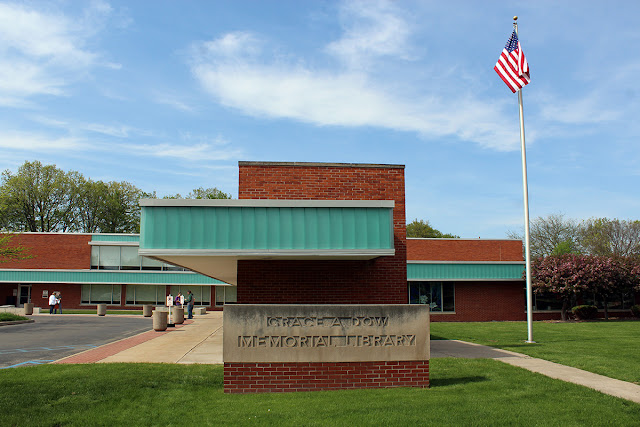
Grace A. Dow Memorial Library, also designed by Dow (That fascia is made of glass! And was evidently just restored last year.)

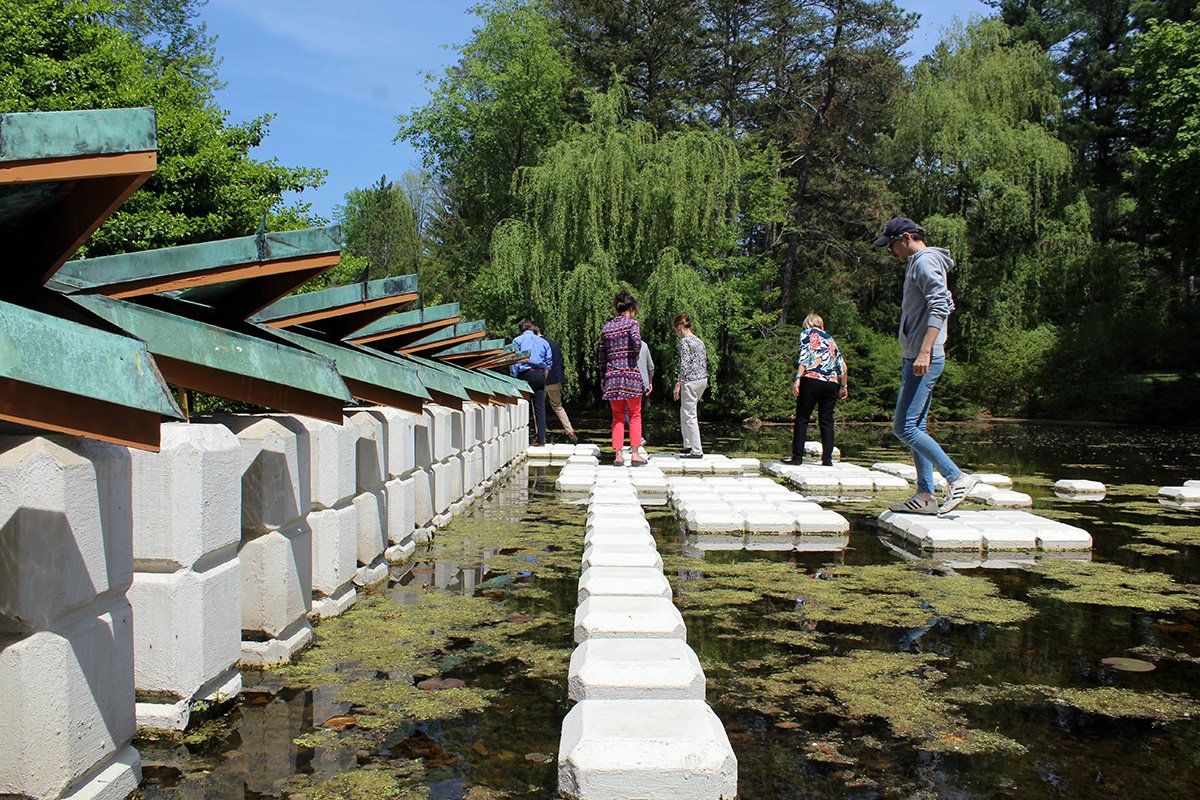
Dow designed his home and studio, nestled among extensive greenery and a manmade pond, between 1934 and 1941.


Seen from either its commercial entrance (above) or residential, the sprawling, low-slung building belies its astonishing 22,000 square feet. I learned from our tour guide that it is constructed primarily out of block made from recycled ash from Dow Chemical. The architect called this material "unit block," and it distinguishes many of his other residential buildings throughout Midland.


The block is everywhere in the house and on the grounds, and also extends the home into the pond via a scattering of pedestrian islands made from the same material, which elegantly collapse the border between the structure and the landscape. This is also a playful gesture, one that invites a visitor to explore, to wander, to hop among the stones—which, according to our guide, was typical of Dow's sensibility.


We couldn't take pictures in the house, but that spirit of adventure or escapade permeates inside, whether in the extreme compression and expansion of space from room to room, in long interior and exterior hallways, or the surprisingly vivid use of bright, saturated colors—pinks, purples, and greens that reference the lush flora outside—to draw one's attention up toward windows and ceilings that soar and fold.


The tour was an extraordinary experience, a rare opportunity to spend time in a truly beautiful, expansive, and well cared for place that was nonetheless human-scale, vivacious, warm, and idiosyncratic—an enlivening, playful, ever-shifting wonderland of ingenious and humane design.

Afterward, we embarked on a couple-hour interlude that basically consisted of us driving around Midland, spotting and pausing to admire more than a dozen modernist homes, and getting to know a friendly local named Laura who was initially suspicious of our interest but then proud to point out a few key streets where we could maximize our mid-century rubbernecking. Then we hit the road to Flint—just about halfway back home from Midland to Detroit.

RIVERBANK PARK

In the mid to late-1970s, Flint's fortunes were faltering. In an effort to revitalize the downtown, boosters and philanthropists organized the construction of a new downtown park to be designed by the firm of Lawrence Halprin (1916-2009), a Bay Area-landscape architect noted for his dynamic public spaces. Or so we learned from Cade Surface, a friend of a friend who has studied Riverbank Park extensively and has advocated for its preservation, and who happens to live just a few blocks away.


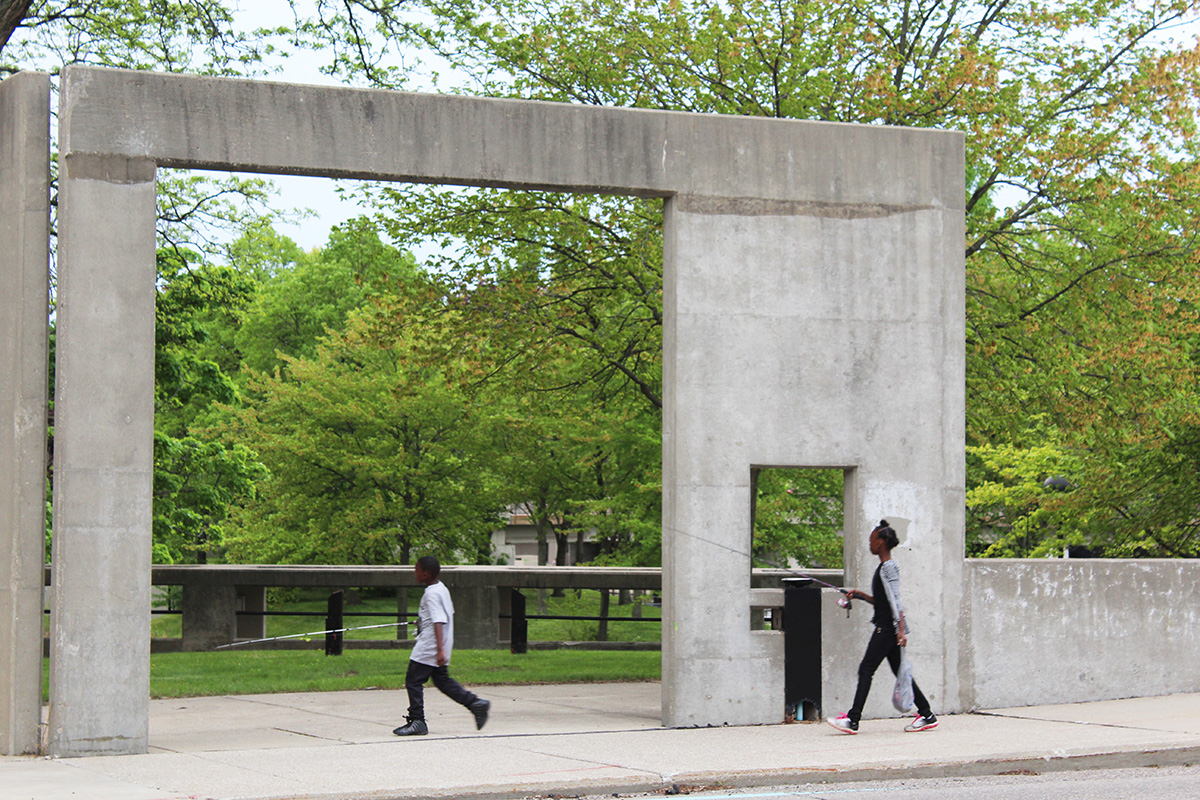
Cade took us all around the ten acre park, explaining that it embodies a key concern of Halprin's, who worked closely with his wife, the choreographer Anna Halprin: it is a space that invites people not simply to walk through it, but to dance—that is, to move through it in various and imaginative ways. In addition to the variety of perspectives it offers from which to watch other people, Riverbank Park, like the Dow House, encourages people to hop from space to space, to climb, to explore, to discover.

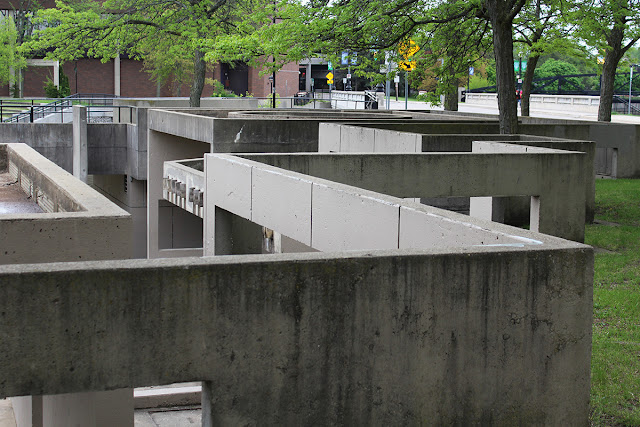


As you can see from the photos, Riverbank Park is made mostly of concrete, a material I'm personally very fond of (hence my interest in going there!). I'm one of those Brutalist weirdos who wants to tell you how soulful concrete is, how comforting and natural. I guess there is something about its sturdy matter-of-factness, or maybe its roots in the ancient world, that draws me to it. And there is, in fact, a classical quality to Riverbank Park, with its succession of outdoor rooms, its oculi and amphitheatre, its insistence on the ideal of the public.


But Riverbank Park was meant to be more than concrete geometric forms, grass, and trees; it was at one time permeated and enlivened by the Flint River itself, via a feat of engineering that involved the use of two nearby dams, an Archimedes screw, and an aqueduct, a system whereby water regularly coursed through the structure, cascading down steps and spouts and into pools and channels.

Photo of functioning Riverbank Park by Adam Pagnier

Currently, the park is dry, which gives it an austere and forlorn feeling. Cade explained that on advice from the federal government, Flint has gone about dismantling the two dams to minimize the risk of flooding downtown. The aqueduct and Archimedes screw have also been removed. It sounds like water can still be made to pass through the park piecemeal, but with effort, and only on special occasions.


The future of the park is uncertain. Our quick visit suggested that it is still used, but in addition to the malfunctioning water system, Riverbank Park does not seem to be well cared for (little wonder, in a city that, according to Cade, has just one full-time employee working for the entire park system). Cade said that one plan calls for most of it to be leveled and replaced with grassland. Along with other community members (including Emma Davis, a dance instructor at UM-Flint, who staged a community-driven performance there in 2014), he continues to advocate for its preservation as a place of local and national distinction, citing its singular character and the fact that numerous of Halprin's other spaces elsewhere in the country remain both vital and protected.

Part of what made our visit to the park somewhat sad is the profound disconnect between the soaring ambitions of its creators (one might say their hubris) and the earthbound economic reality of life in Flint. This was meant to be a grand place, and evidently it was, for a time—but grand places are expensive to maintain. How could Riverbank Park possibly have thrived after the successive social and economic crises that have rocked Flint's beleaguered citizens these last decades?

Even dry, still, skeletal, the park is a beautiful place. Yes, there is something integral missing, but it still feels sacred and surprising, like something from a dream. And in fact, as I fell asleep later that night in Detroit, I started dreaming that I was back there, under the sun, but that there was water rushing all around, down the steps, through the channels, spilling into basins, catching the light, splashing. The park was alive with water. It was a lovely vision of a rare and special place. I don't know if, after an hour and a half introductory visit, I have any right to advocate on behalf of the preservation of Riverbank Park, but I can't help but hope that I'll get a chance to experience that vision for real one day, and that many others will too. 


Monday, February 5, 2018

B-side: Ghost busses and phantom transit data

I published an article in Model D this week that describes my and Michel's surprisingly rich six month experience living car-less in Detroit. In it, I glancingly touched on something I wanted to dig into a little deeper here: my experience using the DDOT bus system.

I'm a very recent DDOT user, having just gotten started in October. As I mentioned in the article, I have really come to love riding the bus in Detroit. I look forward to it, every time, for a whole bunch of reasons.

View from my bus last week

But as much as the system has evidently improved in the last couple years, it still has its problems — namely, busses occasionally not showing up when they're supposed to. As I mentioned in the article, this has been an infrequent occurrence, in my experience, but that doesn't mean that it's not a maddening, frustrating inconvenience when it happens. It's a real killjoy, especially in the cold. It's also unsettling, in a very specific way. You're standing there, squinting into the horizon, hoping to catch a glimpse of the indistinct but telltale orange marquee lights that means a bus is coming, wondering — did I get it wrong? Did I miss the bus? (Did it come early?) Is it five minutes away? Is it ten minutes away? Is it just not coming? Should I call a Lyft? Should I wait for the next one? Then you see those lights, and you feel relieved, but it gets closer and you see that it's not your bus at all, but another line, going someplace else.

Besides the glaring, systemic problem of the bus not being on time, there's another problem here, a human-scale problem: a problem of information. You don't know. There are tools that are supposed to help you know, but these are confusing and, evidently, inaccurate. For instance, the first time I caught the bus, I used DDOT's "Text My Bus" service, where you send a text and get an automatic response telling you how far away the bus is. It worked perfectly — it said the bus was five minutes away, and five minutes later, the bus showed up. But the next time, it said the bus was two minutes away, and two minutes later, no bus. Five minutes later, no bus. Ten minutes later? No bus. I texted again: next bus, 35 minutes. It was like a ghost bus had gone by.

"Use Transit," a friend said when I relayed my experience, referring to the free smartphone app that purports to offer realtime bus tracking info. "It's more accurate." Great! So I downloaded Transit, and after struggling a bit with the so-simple-it's-complicated-interface, I got the hang of it (or thought I did). Transit uses GPS to determine where a user is and shows the buses that should be coming by, displaying a list of upcoming, realtime pickup times. Except, when I started using it...more ghost busses. More confusion. What was going on here? Transit is supposed to be displaying real time data about the busses in Detroit. But is it?

I posed this question to the folks at Transit and got an illuminating response from a friendly representative named Katie. "Transit does in fact offer real-time information in Detroit for DDOT buses as well as SMART buses, and the new Q Line," she wrote. But she said that she noticed that some DDOT busses didn't have realtime data available. You can tell when there is realtime data, she said, by the radio wave icon that appears next to certain departure times. In the screenshot below, realtime data is only available for the 4:48 and 6:12 bus. The other times are all extrapolated from bus schedule data.


It's a subtle thing, that little radio wave icon. I never even noticed it before Katie brought it up, and the folks at Transit would do well to make its significance clearer up front. But now that I know, it's great! At least now, I know what I know, and what I don't. (And a few subsequent tests have proven this out — each time I've seen those radio waves, the bus in question has come right when it's supposed to.)

But that bit that I don't know remains problematic. Why, on the screenshot above, do only two of seven busses have realtime data? Why can't I know exactly when all those busses are coming? To understand that, I turned to Neil Greenberg, manager of service development and scheduling for DDOT. (He's also a bona fide transit enthusiast, a former bus driver, and the mastermind behind Freshwater Railway, the intricate but totally made-up regional Detroit transit system that made a splash in 2011 when it got Detroiters dreaming about what real, connected transit here could look like.)

"The realtime DDOT data just isn't consistent," Neil admitted. It's not reliable." The problem, he said, is that DDOT is using a 25 year old AVL, or automatic vehicle locator, computer system. "When you try and feed data from an old system into a newer system," he said, "things really get messy." So in the transfer, the data become unreliable. Buggy. It's the same problem for Text My Bus that it is with Transit — as users, we simply cannot expect reliable data every time, or even most times. His advice? Use bus schedules instead. The busses, after all, tend to come when they're scheduled, so in the absence of consistent realtime data, the schedule's the most reliable option.

The good news here is that, according to Neil, DDOT is currently embarking on a multi-year tech upgrade that will include a complete replacement of the AVL. "We're investing pretty heavily in all new systems," he said, "not just for the AVL, but downstream from that — apps, data processing, everything that ultimately makes it to the customer's hand. It'll be great to have. We don't just want something new, we want something that we can maintain and keep up to date." He expects the overhaul to be complete in 2019-20, and lists better realtime data as a major goal. He cited other forthcoming improvements, too, including a notification system to alert riders about delays, and a new website that would help make the experience of learning how to use the bus system more straightforward and accessible to more Detroiters.

So evidently, there's a lot to look forward to. For now, of course, the most pressing concern remains the big one: those late or MIA busses. The best way to address that problem, Neil counsels, is to let DDOT know about it. "We really like complaints," he said, "but please don't just blow steam and tell us how we wronged you; tell us when, where, and what line. We need specifics."

Ideally, of course, the bus system wouldn't wrong its riders at all, but as you may have noticed, we don't live in an ideal world. I'm going to keep riding DDOT because I like it and it's convenient and, in my experience, it usually works just fine. I'm sure, here and there, another bus or two is going to not show up, and I'm sure I'll feel frustrated and wronged and curse the fact that we just can't seem to get transit right in this town. But I'm glad I spent some time digging into this, because I'll also take some comfort from the thought that something better might be coming down the road. If I squint, I can almost see it.